
Does PRP Actually Work for Hair Loss? What the Science Says
Platelet-rich plasma (PRP) has become an increasingly popular treatment for hair loss, with patients spending hundreds or even thousands of dollars on scalp injections that promise thicker, fuller hair.
My patients ask me every day: Does PRP ACTUALLY regrow hair, and what's the chance it will work for me?
The short answer: Yes, PRP can improve hair density in some patients, particularly those with androgenetic alopecia (pattern hair loss). However, results vary considerably, treatment protocols are not standardized, and PRP is not a miracle cure.
Let's get into it.
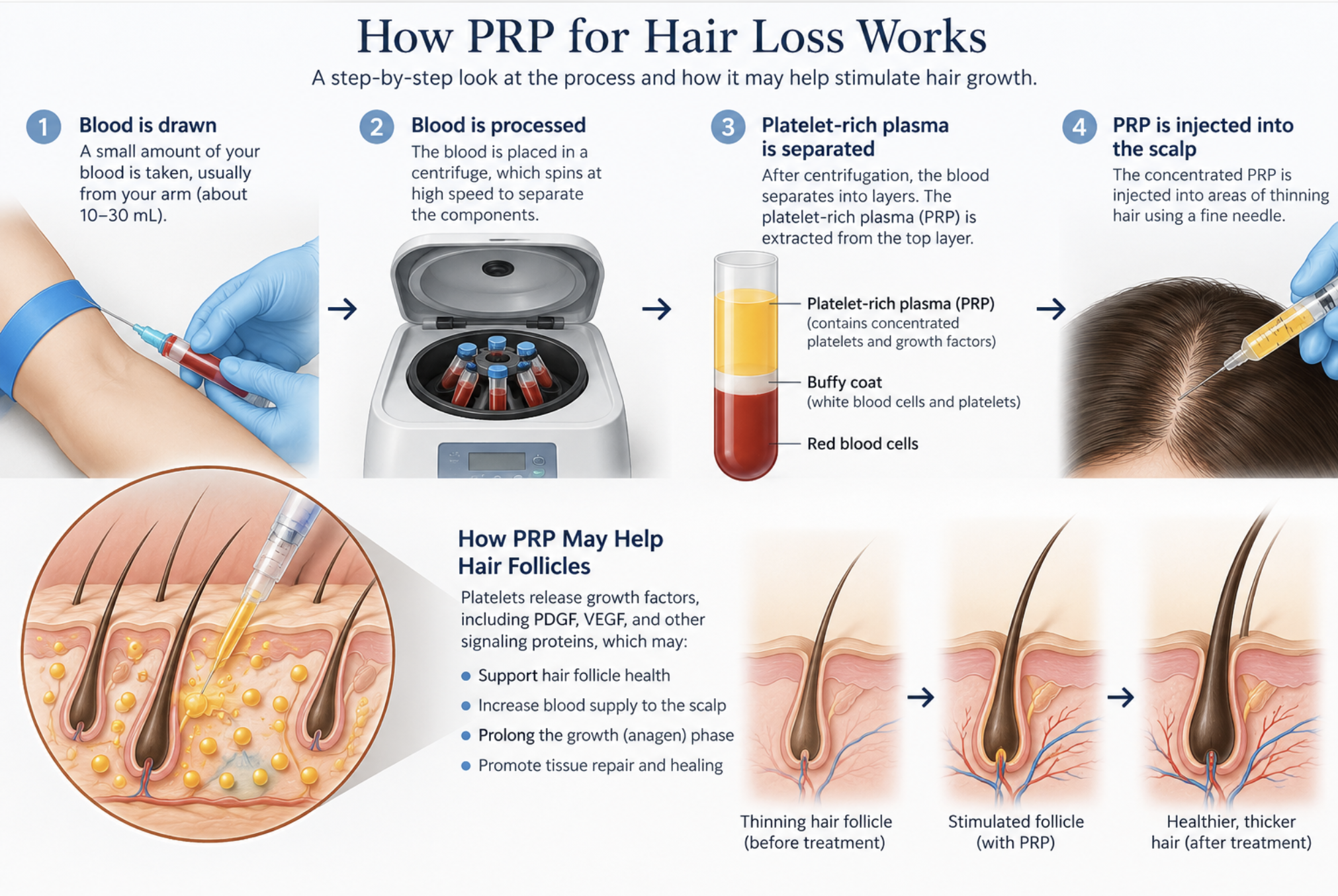
Proposed mechanism of action of PRP.
What Is PRP, and How Does It Work?
Platelet-rich plasma is a treatment derived from your own blood.
During a PRP procedure, a small amount of blood is drawn and placed into a centrifuge, which separates the blood into different components. The platelet-rich portion is then injected into areas of the scalp affected by hair loss.
Platelets contain growth factors, including platelet-derived growth factor (PDGF) and vascular endothelial growth factor (VEGF), that may influence cellular signaling, tissue repair, and hair follicle activity.
The theory is that delivering a concentrated preparation of these growth factors directly to the scalp may help stimulate hair follicles and promote hair growth.
However, a plausible biological mechanism doesn't necessarily mean a treatment works clinically. That's why randomized controlled trials are so important.
Does PRP Actually Regrow Hair?
Several clinical trials and systematic reviews suggest that PRP can increase hair density in patients with androgenetic alopecia, the most common form of hair loss in both men and women.
What Do the Larger Studies Show?
A 2024 systematic review and meta-analysis by Kieling and colleagues, published in Anais Brasileiros de Dermatologia, evaluated 14 randomized controlled trials involving 431 patients.
The pooled analysis found that PRP-treated areas had an average of 27.55 more hairs per square centimeter compared with control areas.
That's a potentially meaningful improvement.
However, the researchers also identified substantial variability between studies, potential publication bias, and overall low certainty of evidence.
A separate 2023 meta-analysis reported an average improvement of approximately 25 additional hairs per square centimeter compared with controls, further supporting PRP's potential to improve hair density.
These findings are encouraging, but average results from clinical trials should not be interpreted as a guarantee of individual improvement.
What Percentage of Patients Actually Respond?
A randomized controlled trial by Dubin and colleagues, published in the Journal of the American Academy of Dermatology, studied 30 women with androgenetic alopecia.
At 24 weeks, 57% of patients treated with PRP showed visible improvement compared with just 7% receiving placebo, based on blinded photographic assessment (p < 0.01).
The PRP group also demonstrated improvements in hair density and caliber.
This is particularly interesting because it demonstrates two important points: PRP can produce clinically visible improvement, but not every patient responds.
Importantly, the 57% figure represents improvement in this particular clinical trial, not a universal response rate for PRP.
Why Are PRP Study Results So Inconsistent?
One of the biggest challenges in interpreting PRP research is that not all PRP treatments are the same.
Studies differ in several important ways:
Platelet concentration: The number of platelets delivered can vary depending on how PRP is prepared.
Preparation methods: Different centrifugation systems produce different PRP formulations.
Treatment protocols: Studies use different injection volumes, treatment intervals, and numbers of sessions.
Patient characteristics: Hair loss severity, duration, and individual biological differences may influence outcomes.
Outcome measurements: Researchers use different methods to assess hair growth.
This makes it difficult to compare studies directly or determine which PRP protocol is most effective.
It also means that results obtained using one PRP system cannot automatically be generalized to every PRP treatment offered in clinical practice.
Who Is Most Likely to Benefit From PRP?
The strongest clinical evidence supports PRP for androgenetic alopecia, also known as male or female pattern hair loss.
PRP may be considered for patients with thinning hair who want to explore additional treatment options, particularly alongside established medical therapies.
However, PRP is not equally well studied for every type of hair loss.
In my practice, I also offer PRP to select patients with telogen effluvium and certain scarring alopecias, although these decisions are made on a case-by-case basis. The evidence for these conditions is more limited, and PRP should not replace treatment of the underlying cause of hair loss.
Most importantly, there is currently no reliable, validated method to predict which individual patients will respond to PRP.
Some patients experience noticeable improvement, while others see little or no benefit.
How Many PRP Treatments Are Needed?
PRP is generally performed as a series of treatments rather than a single injection session.
Many clinical protocols begin with approximately three monthly treatments, followed by periodic maintenance sessions.
However, there is no universally established optimal treatment schedule.
Hair growth also takes time. Patients are generally assessed over several months, rather than expecting visible improvement immediately after treatment.
Because androgenetic alopecia is a chronic, progressive condition, ongoing treatment may be needed to maintain results.
Is PRP Better Than Minoxidil?
PRP and minoxidil work through different mechanisms, and they are not necessarily competing treatments.
Minoxidil is an established treatment for pattern hair loss with a substantial body of clinical evidence.
PRP is a procedural treatment that may provide additional benefits for some patients.
A 2024 systematic review and meta-analysis examining PRP combined with topical minoxidil found improvements in hair density compared with minoxidil alone.
However, the included studies had methodological limitations, and additional high-quality research is needed.
For many patients, PRP is best considered a potential adjunct to established hair loss treatments rather than an automatic replacement for them.
Does PRP Help Hair Transplant Results?
PRP isn't just used as a standalone treatment for hair loss. It can also be incorporated into hair transplantation procedures, including follicular unit extraction (FUE) and follicular unit transplantation (FUT).
The goal is to potentially improve graft survival, support healing, and promote earlier hair growth.
PRP Before a Hair Transplant: Does It Help?
PRP may be used before surgery to improve the condition of existing, thinning hair and potentially optimize the recipient scalp.
However, there is limited direct evidence that preoperative PRP improves subsequent hair transplant outcomes.
It should not be considered a necessary preparation for surgery.
PRP During Hair Transplant Surgery
PRP can be administered during surgery, including through injections into the recipient area or by incorporating PRP into graft-handling protocols.
The proposed benefits include supporting graft survival, promoting tissue healing, and encouraging earlier hair growth.
A 2025 systematic review evaluated three controlled studies involving 217 patients undergoing hair transplantation. Across these studies, PRP was associated with improvements in outcomes such as hair density, graft survival, and earlier hair growth.
However, the studies used different PRP preparations and treatment protocols, making it difficult to determine the optimal approach or magnitude of benefit.
PRP After a Hair Transplant: Does It Improve Growth?
PRP may also be used after transplantation to support the surrounding native hair and potentially improve postoperative hair growth.
However, evidence specifically evaluating postoperative PRP protocols remains limited. There is no established optimal timing or frequency of treatment following hair transplantation.
Importantly, PRP does not replace appropriate surgical technique, careful graft handling, or ongoing medical treatment for progressive hair loss.
My take: PRP may be a useful adjunct to hair transplantation, particularly when incorporated into a comprehensive treatment plan. However, it is not essential for a successful transplant, and the evidence is not yet strong enough to recommend it routinely for every patient.
Is PRP Safe?
Because PRP is prepared from a patient's own blood, the risk of allergic reactions to the injected material is generally low.
However, PRP injections are not entirely risk-free.
Potential adverse effects include:
Temporary scalp tenderness or pain
Redness and swelling
Bruising or pinpoint bleeding
Rare complications such as infection
PRP should be performed by an appropriately trained medical professional using sterile techniques.
Is PRP Worth the Money?
This is where the decision becomes more individualized.
PRP treatments can cost hundreds to thousands of dollars, particularly when multiple sessions and ongoing maintenance are required.
For patients with androgenetic alopecia, PRP may offer meaningful improvement in hair density. But results are variable, treatment protocols are not standardized, and the financial investment can be substantial.
Before pursuing PRP, I recommend obtaining an accurate diagnosis and discussing the evidence, costs, and alternatives with a dermatologist experienced in treating hair loss.
The Bottom Line: Does PRP Work for Hair Loss?
PRP is a promising treatment with clinical evidence supporting improvements in hair density, particularly for androgenetic alopecia.
But there are several important caveats:
PRP can improve hair density, but not every patient responds.
Studies use different preparation methods and treatment protocols.
The overall certainty of evidence remains limited.
There is no reliable way to predict individual treatment response.
PRP may be most useful as part of a comprehensive hair loss treatment plan.
PRP is not a miracle cure, but it is also not simply a marketing gimmick.
For appropriately selected patients, it may be a reasonable treatment option when its limitations are clearly understood.
About the Author
Dr. Dawn Queen, MD is a board-certified dermatologist in New York City specializing in medical dermatology, cosmetic dermatology, and hair loss. She serves as a Clinical Assistant Professor of Dermatology at Columbia University and completed an ISHRS-accredited hair restoration fellowship.
Learn more about Dr. Queen.
Frequently Asked Questions About PRP for Hair Loss
Does PRP actually regrow hair?
Yes, PRP can improve hair density in some patients, particularly those with androgenetic alopecia (pattern hair loss). Clinical studies have demonstrated improvements in hair density, although results vary and not everyone responds to treatment.
How long does it take to see results from PRP?
Patients who respond to PRP may begin noticing improvements within approximately 3–6 months. Because hair grows slowly, results are gradual, and multiple treatment sessions are typically needed.
How many PRP sessions are needed for hair growth?
A common treatment protocol involves three initial sessions spaced approximately one month apart, followed by maintenance treatments every 3–6 months. However, there is no universally standardized protocol, and treatment schedules vary between practices.
How long do PRP hair growth results last?
PRP results are not necessarily permanent. Because androgenetic alopecia is a progressive condition, maintenance treatments may be necessary to sustain improvements. The optimal maintenance schedule and long-term durability of PRP results remain incompletely established.
Does PRP work for female pattern hair loss?
Yes, PRP may improve hair density in women with female pattern hair loss. In a randomized controlled trial by Dubin and colleagues, 57% of PRP-treated women demonstrated visible improvement at 24 weeks, compared with 7% receiving placebo. However, this result comes from a relatively small study and should not be interpreted as a universal response rate.
Can PRP regrow hair in completely bald areas?
PRP is unlikely to restore meaningful hair growth in areas where functional hair follicles are no longer present. It is generally more appropriate for areas of thinning hair with remaining viable follicles than for longstanding areas of complete baldness.
Is PRP better than minoxidil for hair loss?
Not necessarily. Minoxidil has a more established evidence base and is generally more accessible and affordable. PRP may provide additional benefits for some patients, particularly when used alongside established hair loss treatments. Current evidence does not establish PRP as consistently superior to minoxidil.
What Is the Difference Between PRP and PRF for Hair Loss?
PRP (platelet-rich plasma) and PRF (platelet-rich fibrin) are both treatments derived from a patient's own blood, but they differ in how they are prepared.
PRP is a platelet-concentrated plasma preparation, while PRF contains a fibrin matrix that may allow for a more gradual release of growth factors. Injectable PRF (i-PRF) is a liquid formulation that can be administered into the scalp.
Both treatments are being studied for hair loss, but PRP currently has a larger body of clinical evidence.
A 2026 randomized clinical trial comparing PRP, injectable PRF, and concentrated growth factors in women with pattern hair loss reported greater improvements in non-vellus hair count with injectable PRF than PRP at 24 weeks. However, this was one relatively small study, and larger trials are needed to establish whether PRF consistently produces better results.
The bottom line: PRF is promising, but there is not yet enough evidence to conclude that it is generally superior to PRP for hair regrowth.
References
Kieling L, Konzen AT, Zanella RK, Valente DS. Is autologous platelet-rich plasma capable of increasing hair density in patients with androgenic alopecia? A systematic review and meta-analysis of randomized clinical trials. Anais Brasileiros de Dermatologia. 2024. https://pubmed.ncbi.nlm.nih.gov/39013743/
Dubin DP, Lin MJ, Leight HM, et al. The effect of platelet-rich plasma on female androgenetic alopecia: A randomized controlled trial. Journal of the American Academy of Dermatology. 2020. https://pubmed.ncbi.nlm.nih.gov/32649961/
Effectiveness of Platelet-Rich Plasma in the Treatment of Androgenic Alopecia: A Meta-Analysis. 2023. https://pubmed.ncbi.nlm.nih.gov/37644190/
Donnelly RF, et al. The role of platelet-rich plasma in androgenetic alopecia: A systematic review. Journal of Cosmetic Dermatology. 2024. https://pubmed.ncbi.nlm.nih.gov/38284294/
The additive value of platelet-rich plasma to topical Minoxidil in the treatment of androgenetic alopecia: A systematic review and meta-analysis. 2024. https://pubmed.ncbi.nlm.nih.gov/39197003/
Sindhusen S, et al. Efficacy of Platelet-Rich Plasma as an Adjunct to Hair Transplantation: A Systematic Review. Cureus. 2025. https://pubmed.ncbi.nlm.nih.gov/41069573/
Comparative efficacy and safety of platelet-rich plasma (PRP), injectable platelet-rich fibrin (i-PRF) and concentrated growth factors (CGF) for female pattern hair loss (FPHL): a prospective multicenter randomized clinical trial. 2026. https://pubmed.ncbi.nlm.nih.gov/42041234/
What Do the 12-Month Breezula Results Show?
In April 2026, Cosmo announced additional findings from the 12-month Phase III program.
Participants who continued clascoterone treatment reportedly experienced further improvements in hair count through 12 months. Those who switched from active treatment to vehicle after six months lost some of their earlier gains.
This suggests that Breezula, like finasteride and minoxidil, would likely require continued use to maintain its effects.
Importantly, the extension phase included participants who reported a positive response during the initial six months, so these findings may not reflect the experience of every patient who starts treatment.
Breezula vs. Finasteride: Which Is Better?
This is one of the most interesting questions about Breezula.
Finasteride is an established treatment for male pattern hair loss. By inhibiting the conversion of testosterone into DHT, it can help slow further hair loss and improve hair density.
Breezula targets the same androgen pathway differently, blocking androgen receptors locally rather than reducing DHT production.
One potential advantage of Breezula is its localized mechanism of action, which could reduce the risk of systemic adverse effects, including sexual side effects associated with oral finasteride.
However, we cannot currently conclude that Breezula is more effective or safer than finasteride. There are insufficient direct comparative data, and a topical mechanism alone does not establish an absence of systemic side effects.
For patients concerned about taking oral medications, Breezula could eventually become another option, provided it receives regulatory approval.
What Are the Side Effects of Breezula?
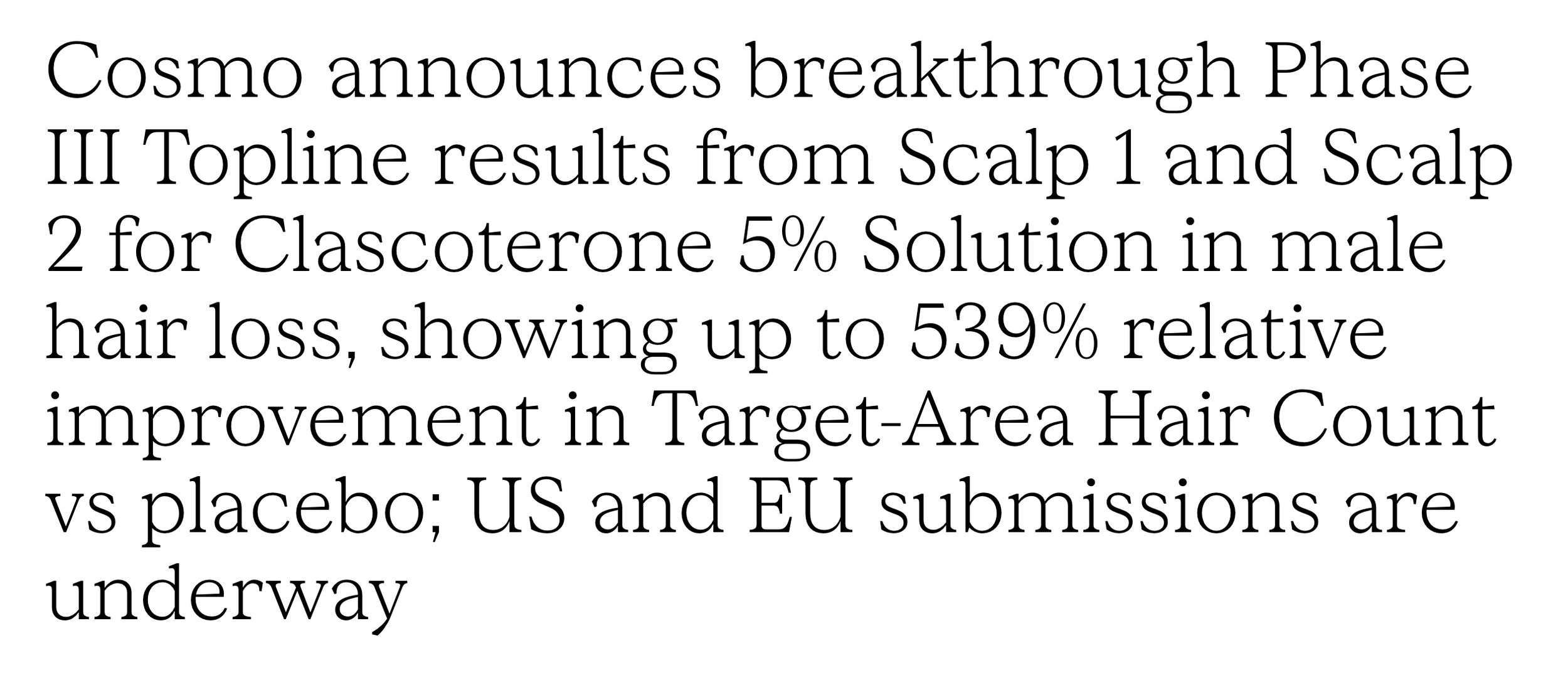
According to Cosmo's Phase III announcements, clascoterone 5% topical solution demonstrated a generally favorable safety and tolerability profile, with adverse events comparable to vehicle.
The company also reported no significant systemic hormonal side effects through 12 months of treatment.
As with other topical medications, local reactions such as redness, itching, dryness, or irritation are potential considerations. However, the publicly released Phase III results do not yet provide a detailed breakdown of individual adverse events, so we cannot reliably determine how frequently these reactions occur with Breezula.
Although clascoterone 1% cream is already FDA-approved for acne, its safety profile cannot automatically be extrapolated to the higher-concentration scalp formulation.
Can Breezula Be Used by Women?
The pivotal Phase III trials studied Breezula in men with androgenetic alopecia.
There is currently insufficient evidence to establish the efficacy and safety of clascoterone 5% solution for female pattern hair loss.
Although androgen signaling can contribute to hair loss in women, additional clinical research is needed before we can determine whether Breezula has a role in treating female patients.
When Will Breezula Be FDA-Approved?
As of October 2026, Breezula is not FDA-approved for androgenetic alopecia.
Cosmo Pharmaceuticals has announced plans for a U.S. regulatory submission in early 2027.
However, regulatory submission does not guarantee approval, and the FDA must review the complete efficacy and safety data before making a decision.
There is currently no confirmed U.S. availability date.
My Perspective as a Hair Restoration Specialist
What makes Breezula particularly interesting is its mechanism of action. A topical medication that directly targets androgen receptors could expand treatment options for men with androgenetic alopecia, particularly those who prefer to avoid oral medications.
The Phase III findings are promising, but I would like to see the complete published results, including absolute hair-count changes, photographic assessments, and detailed safety outcomes. Direct comparisons with established treatments would also help clarify where Breezula fits into clinical practice.
For now, Breezula represents a promising investigational treatment, but it is not yet a replacement for established therapies.
For patients experiencing hair loss, treatment options already range from medications to hair transplantation, depending on the extent of hair loss and individual goals. I offer hair loss consultations in New York City, including medical and surgical treatment options.
For more emerging therapies, read my overview of new hair loss treatments in 2026.
About the Author
Dr. Dawn Queen, MD is a board-certified dermatologist in New York City specializing in medical dermatology, cosmetic dermatology, and hair loss. She serves as a Clinical Assistant Professor of Dermatology at Columbia University and completed an ISHRS-accredited hair restoration fellowship.
Learn more about Dr. Queen.
Frequently Asked Questions
Is Breezula FDA-approved for hair loss?
No. As of October 2026, Breezula (clascoterone 5% topical solution) remains investigational and is not FDA-approved for androgenetic alopecia. The manufacturer has announced plans for a U.S. regulatory submission in early 2027.
Is Breezula the same as Winlevi?
Both contain the active ingredient clascoterone, but they are different formulations developed for different conditions. Winlevi is a 1% cream approved for acne, while Breezula is an investigational 5% topical solution being developed for male pattern hair loss. They should not be considered interchangeable.
Is Breezula better than finasteride?
We don't know yet. Breezula and finasteride target androgen signaling through different mechanisms, but there are insufficient direct comparative clinical data to determine which is more effective or has a better overall safety profile.
Does Breezula cause sexual side effects?
Breezula is designed to act locally at the scalp, potentially limiting systemic anti-androgen effects. The manufacturer has reported favorable systemic safety findings in Phase III trials, but more detailed published data are needed to fully characterize the risk of sexual and other systemic adverse effects.
Can Breezula regrow a receding hairline?
Breezula has demonstrated improvements in target-area hair count in clinical trials involving men with androgenetic alopecia. However, the extent to which it can restore a receding hairline specifically remains uncertain. Like other medications for pattern hair loss, it is not expected to reliably restore areas where follicles are no longer capable of producing hair.
Will Breezula replace minoxidil or finasteride?
Not necessarily. If approved, Breezula could provide another treatment option with a different mechanism of action. Additional studies will be needed to determine whether it works best alone or in combination with existing therapies.
Will you need to use Breezula forever?
Probably for as long as you want to maintain its benefits. The 12-month trial findings suggest that improvements may diminish after treatment is discontinued. This is consistent with the chronic, progressive nature of androgenetic alopecia.
When will Breezula be available in the United States?
There is no confirmed release date. The manufacturer has announced plans to submit a U.S. regulatory application in early 2027, but availability will depend on FDA review and approval.
This article is intended for educational purposes only and does not constitute individualized medical advice. Breezula (clascoterone 5% topical solution) remains investigational and is not FDA-approved for hair loss.
References
Cosmo Pharmaceuticals. Phase III topline results from SCALP 1 and SCALP 2. December 3, 2025.
Cosmo Pharmaceuticals. Phase III 12-month clascoterone 5% topical solution results. April 15, 2026.
ClinicalTrials.gov. SCALP 1 (NCT05910450) and SCALP 2 (NCT05914805).
