
Breezula for Hair Loss: Results, Side Effects & FDA Status
If you've been following the latest developments in hair loss treatments, you may have heard about Breezula, a new topical medication that has shown promising results in clinical trials for male pattern hair loss.
With positive Phase III results announced in 2025 and additional 12-month data released in 2026, Breezula is attracting considerable attention. But what does the research actually show? And could it eventually replace medications like finasteride or minoxidil?
As a dermatologist specializing in medical and surgical hair restoration, I think Breezula is an interesting development. However, there are some important limitations to understand before getting too excited.
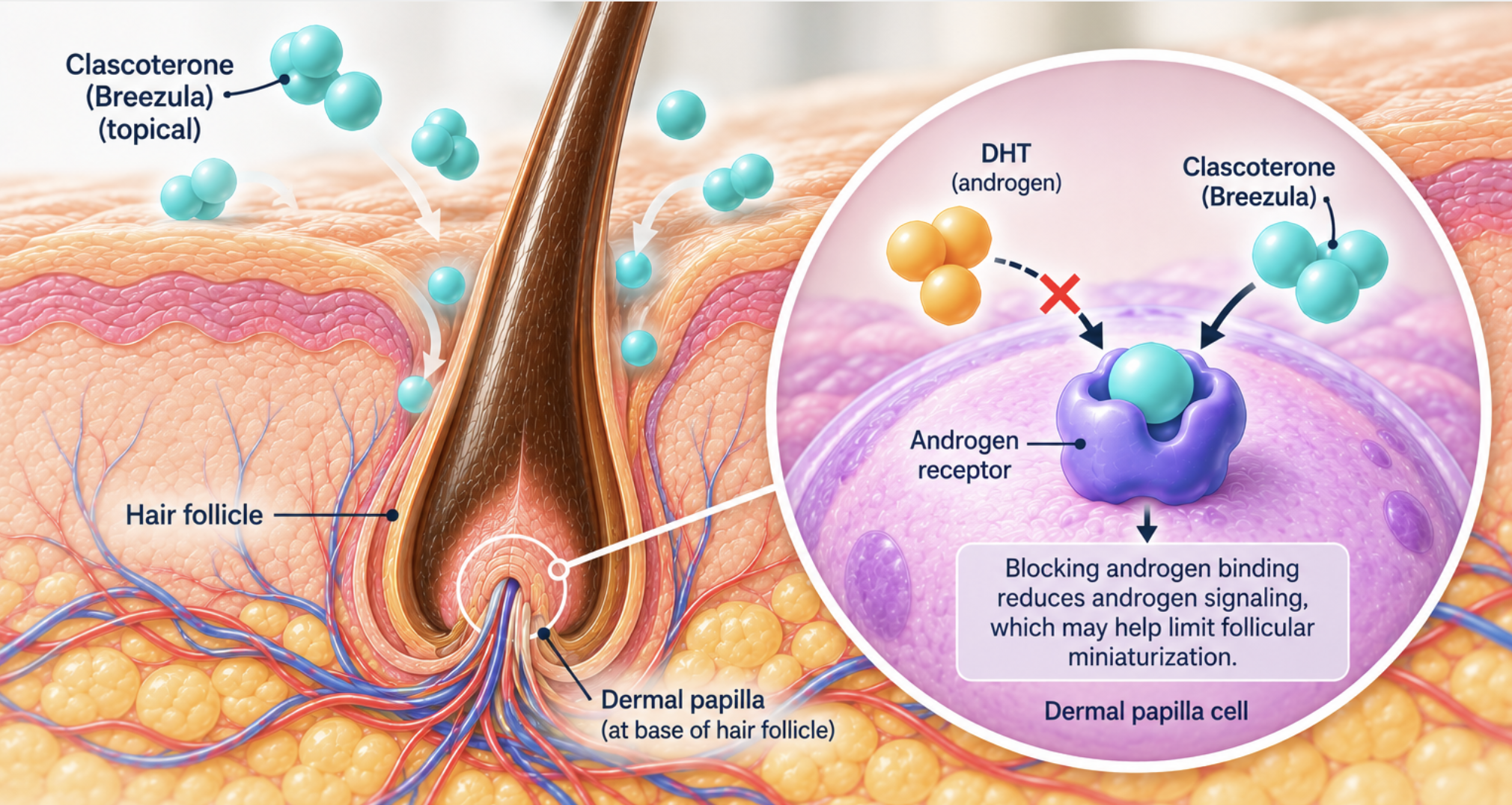
Proposed mechanism of action of clascoterone (Breezula) in androgenetic alopecia. Clascoterone is a topical androgen receptor antagonist that competes with dihydrotestosterone (DHT) for binding to androgen receptors in hair follicle cells, including dermal papilla cells. By reducing androgen signaling, clascoterone may help limit follicular miniaturization. Illustration is schematic and does not represent the precise drug penetration pathway.
What Is Breezula, and How Does It Work?
Breezula is the investigational brand name for clascoterone 5% topical solution, a medication being developed for male androgenetic alopecia, also known as male pattern hair loss.
Male pattern hair loss is largely driven by genetics and sensitivity to dihydrotestosterone (DHT), an androgen that causes susceptible hair follicles to progressively miniaturize. Over time, these follicles produce thinner and shorter hairs.
Breezula works differently from currently approved hair loss medications. Clascoterone is an androgen receptor inhibitor, meaning it is designed to block the effects of androgens directly at the hair follicle.
For comparison:
Finasteride inhibits the enzyme 5-alpha-reductase, reducing the conversion of testosterone into DHT.
Minoxidil promotes hair growth through mechanisms that are not fully understood.
Breezula aims to block androgen signaling locally at the scalp.
Interestingly, clascoterone isn't an entirely new ingredient. A lower-concentration 1% cream is already FDA-approved for acne under the brand name Winlevi. This crossover makes sense because androgens play a role in both conditions, influencing sebum production in acne and hair follicle miniaturization in androgenetic alopecia.
However, the 5% scalp solution is a different formulation and has not yet been approved for hair loss.
Does Breezula Actually Work? What the Phase III Trials Show
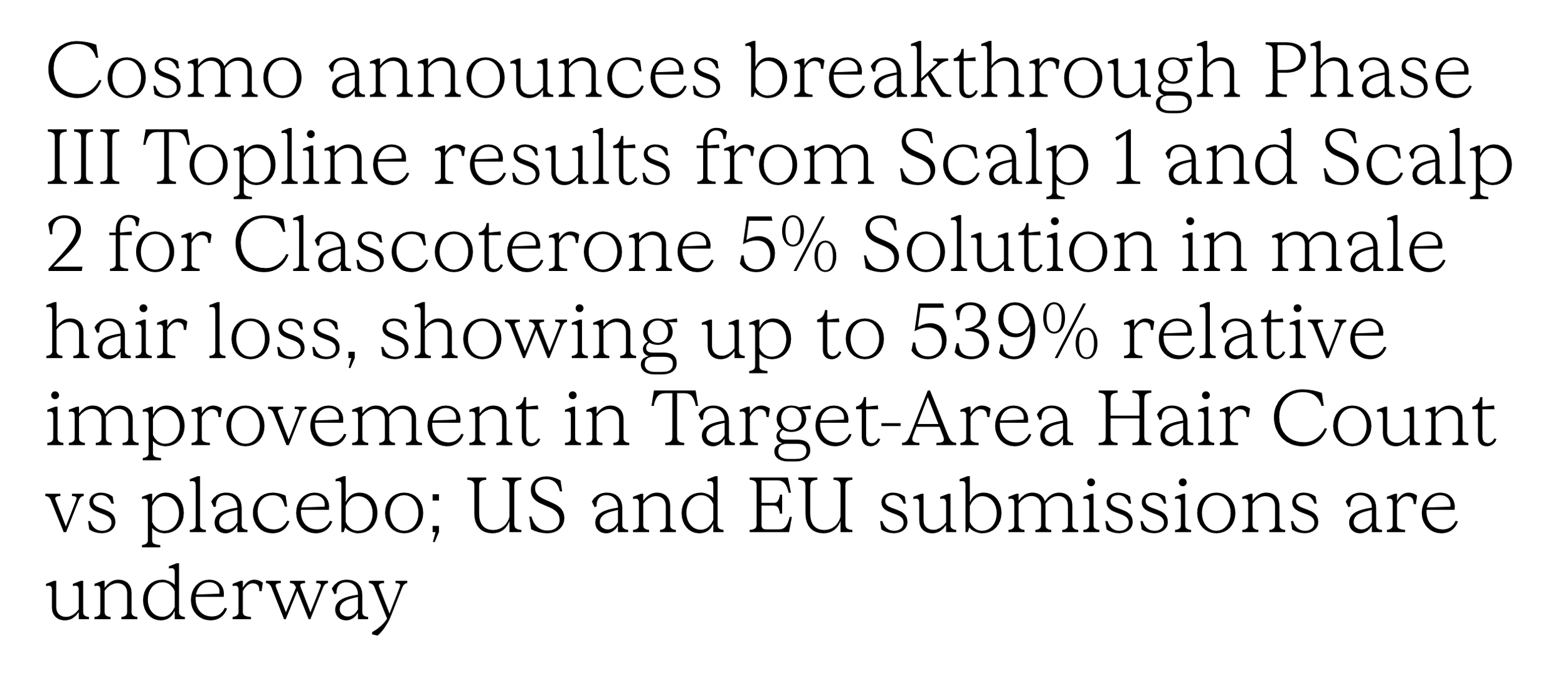
In December 2025, Cosmo Pharmaceuticals announced results from two Phase III clinical trials, SCALP 1 and SCALP 2, involving a combined 1,465 men with androgenetic alopecia.
Both Phase III trials demonstrated statistically significant improvements in target-area hair count compared with vehicle. However, patient-reported outcomes were statistically significant in one trial and showed a positive trend in the other.
The company reported a 539% relative improvement in one trial and a 168% relative improvement in the other.
But here's an important distinction: a 539% relative improvement does not mean patients grew 539% more hair.
These percentages describe the relative treatment effect compared with vehicle, not the percentage increase in an individual's total hair count.
Patient-reported outcomes were also evaluated. One trial demonstrated a statistically significant improvement in patient-reported hair growth, while the other showed a positive trend. The pooled analysis of patient-reported outcomes was statistically significant.
To better understand the clinical significance of these findings, we need to evaluate the absolute hair-count changes and other outcomes, including how noticeable the improvement was to patients.
The results are encouraging, particularly because both large studies met their objective hair-count endpoints. However, the findings have been communicated through company announcements, and full peer-reviewed Phase III efficacy data are still needed for a more complete assessment.
What Do the 12-Month Breezula Results Show?
In April 2026, Cosmo announced additional findings from the 12-month Phase III program.
Participants who continued clascoterone treatment reportedly experienced further improvements in hair count through 12 months. Those who switched from active treatment to vehicle after six months lost some of their earlier gains.
This suggests that Breezula, like finasteride and minoxidil, would likely require continued use to maintain its effects.
Importantly, the extension phase included participants who reported a positive response during the initial six months, so these findings may not reflect the experience of every patient who starts treatment.
Breezula vs. Finasteride: Which Is Better?
This is one of the most interesting questions about Breezula.
Finasteride is an established treatment for male pattern hair loss. By inhibiting the conversion of testosterone into DHT, it can help slow further hair loss and improve hair density.
Breezula targets the same androgen pathway differently, blocking androgen receptors locally rather than reducing DHT production.
One potential advantage of Breezula is its localized mechanism of action, which could reduce the risk of systemic adverse effects, including sexual side effects associated with oral finasteride.
However, we cannot currently conclude that Breezula is more effective or safer than finasteride. There are insufficient direct comparative data, and a topical mechanism alone does not establish an absence of systemic side effects.
For patients concerned about taking oral medications, Breezula could eventually become another option, provided it receives regulatory approval.
What Are the Side Effects of Breezula?
According to Cosmo's Phase III announcements, clascoterone 5% topical solution demonstrated a generally favorable safety and tolerability profile, with adverse events comparable to vehicle.
The company also reported no significant systemic hormonal side effects through 12 months of treatment.
As with other topical medications, local reactions such as redness, itching, dryness, or irritation are potential considerations. However, the publicly released Phase III results do not yet provide a detailed breakdown of individual adverse events, so we cannot reliably determine how frequently these reactions occur with Breezula.
Although clascoterone 1% cream is already FDA-approved for acne, its safety profile cannot automatically be extrapolated to the higher-concentration scalp formulation.
Can Breezula Be Used by Women?
The pivotal Phase III trials studied Breezula in men with androgenetic alopecia.
There is currently insufficient evidence to establish the efficacy and safety of clascoterone 5% solution for female pattern hair loss.
Although androgen signaling can contribute to hair loss in women, additional clinical research is needed before we can determine whether Breezula has a role in treating female patients.
When Will Breezula Be FDA-Approved?
As of October 2026, Breezula is not FDA-approved for androgenetic alopecia.
Cosmo Pharmaceuticals has announced plans for a U.S. regulatory submission in early 2027.
However, regulatory submission does not guarantee approval, and the FDA must review the complete efficacy and safety data before making a decision.
There is currently no confirmed U.S. availability date.
My Perspective as a Hair Restoration Specialist
What makes Breezula particularly interesting is its mechanism of action. A topical medication that directly targets androgen receptors could expand treatment options for men with androgenetic alopecia, particularly those who prefer to avoid oral medications.
The Phase III findings are promising, but I would like to see the complete published results, including absolute hair-count changes, photographic assessments, and detailed safety outcomes. Direct comparisons with established treatments would also help clarify where Breezula fits into clinical practice.
For now, Breezula represents a promising investigational treatment, but it is not yet a replacement for established therapies.
For patients experiencing hair loss, treatment options already range from medications to hair transplantation, depending on the extent of hair loss and individual goals. I offer hair loss consultations in New York City, including medical and surgical treatment options.
For more emerging therapies, read my overview of new hair loss treatments in 2026.
About the Author
Dr. Dawn Queen, MD is a board-certified dermatologist in New York City specializing in medical dermatology, cosmetic dermatology, and hair loss. She serves as a Clinical Assistant Professor of Dermatology at Columbia University and completed an ISHRS-accredited hair restoration fellowship.
Learn more about Dr. Queen.
Frequently Asked Questions
Is Breezula FDA-approved for hair loss?
No. As of October 2026, Breezula (clascoterone 5% topical solution) remains investigational and is not FDA-approved for androgenetic alopecia. The manufacturer has announced plans for a U.S. regulatory submission in early 2027.
Is Breezula the same as Winlevi?
Both contain the active ingredient clascoterone, but they are different formulations developed for different conditions. Winlevi is a 1% cream approved for acne, while Breezula is an investigational 5% topical solution being developed for male pattern hair loss. They should not be considered interchangeable.
Is Breezula better than finasteride?
We don't know yet. Breezula and finasteride target androgen signaling through different mechanisms, but there are insufficient direct comparative clinical data to determine which is more effective or has a better overall safety profile.
Does Breezula cause sexual side effects?
Breezula is designed to act locally at the scalp, potentially limiting systemic anti-androgen effects. The manufacturer has reported favorable systemic safety findings in Phase III trials, but more detailed published data are needed to fully characterize the risk of sexual and other systemic adverse effects.
Can Breezula regrow a receding hairline?
Breezula has demonstrated improvements in target-area hair count in clinical trials involving men with androgenetic alopecia. However, the extent to which it can restore a receding hairline specifically remains uncertain. Like other medications for pattern hair loss, it is not expected to reliably restore areas where follicles are no longer capable of producing hair.
Will Breezula replace minoxidil or finasteride?
Not necessarily. If approved, Breezula could provide another treatment option with a different mechanism of action. Additional studies will be needed to determine whether it works best alone or in combination with existing therapies.
Will you need to use Breezula forever?
Probably for as long as you want to maintain its benefits. The 12-month trial findings suggest that improvements may diminish after treatment is discontinued. This is consistent with the chronic, progressive nature of androgenetic alopecia.
When will Breezula be available in the United States?
There is no confirmed release date. The manufacturer has announced plans to submit a U.S. regulatory application in early 2027, but availability will depend on FDA review and approval.
This article is intended for educational purposes only and does not constitute individualized medical advice. Breezula (clascoterone 5% topical solution) remains investigational and is not FDA-approved for hair loss.
References
Cosmo Pharmaceuticals. Phase III topline results from SCALP 1 and SCALP 2. December 3, 2025.
Cosmo Pharmaceuticals. Phase III 12-month clascoterone 5% topical solution results. April 15, 2026.
ClinicalTrials.gov. SCALP 1 (NCT05910450) and SCALP 2 (NCT05914805).
