
New Hair Loss Treatments in 2026: What’s Next for Androgenetic Alopecia?
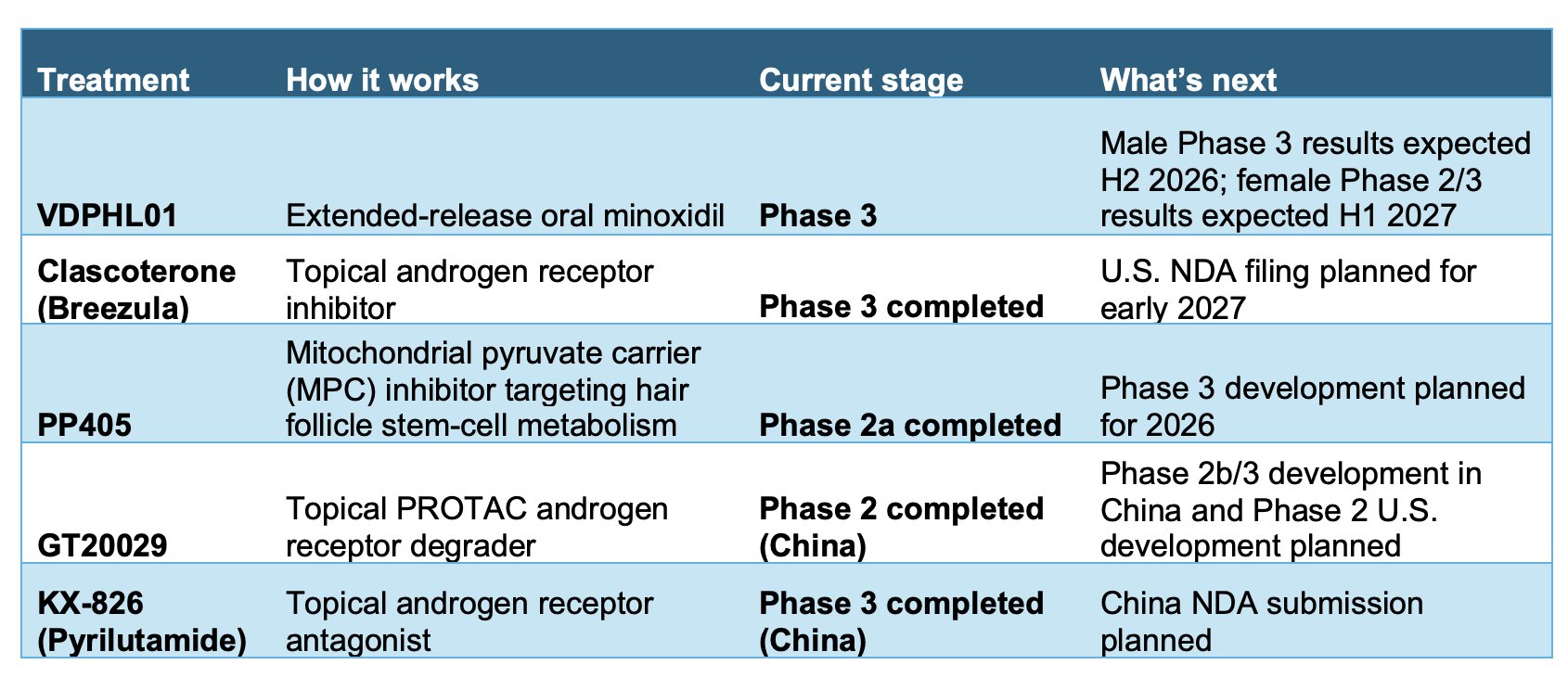
My patients are always asking me what’s new in hair loss treatment. If you have androgenetic alopecia, also known as male or female pattern hair loss, you’ve probably heard about the same treatments for years: minoxidil, finasteride, spironolactone, platelet-rich plasma (PRP), and hair transplantation, to name a few.
But for the first time in a while, the hair loss treatment pipeline is getting hot.
Several new hair loss medications are now in clinical development for androgenetic alopecia, including a new formulation of an old favorite, topical medications that target androgen signaling directly in the scalp, and even a drug designed to reactivate dormant hair follicle stem cells.
As a board-certified dermatologist specializing in hair loss and hair restoration, I’m particularly interested in four treatments currently making their way through clinical development: VDPHL01, clascoterone (Breezula), PP405, and GT20029.
Some are much closer to potentially reaching the market than others. And while headlines promising a new “cure for baldness” can get ahead of the science, there are some genuinely exciting developments worth watching.
1. VDPHL01: A New Oral Minoxidil for Hair Loss?
Oral minoxidil isn't new. In fact, it’s an O.G. at this point. Low-dose oral minoxidil has been used off-label to treat both male and female pattern hair loss for years.
What's new is VDPHL01, an investigational extended-release formulation of oral minoxidil being developed specifically for pattern hair loss.
The formulation is designed to provide more sustained minoxidil exposure while avoiding the high peak concentrations seen with immediate-release oral minoxidil, potentially offering a different dosing and tolerability profile.
And the clinical program is already fairly advanced.
In a Phase 2/3 trial of more than 500 men with mild-to-moderate pattern hair loss, VDPHL01 produced increases in non-vellus hair counts of approximately 30–33 hairs/cm² at six months, compared with about 7 hairs/cm² with placebo.
VDPHL01 is being studied for female pattern hair loss as well. In an open-label Phase 2 study in women, average non-vellus hair counts increased by approximately 23 hairs/cm² at six months. A larger registration-directed Phase 2/3 trial in women is now fully enrolled.
If ultimately approved, VDPHL01 could represent something we have never had before: an FDA-approved extended-release oral minoxidil developed specifically for pattern hair loss.
Now, this isn’t revolutionary. It’s still minoxidil.
But it’s one to watch. Will patients be willing to potentially spend more for a formulation specifically developed and FDA approved for hair loss, or will they continue to favor inexpensive generic oral minoxidil?
2. Breezula for Hair Loss: A New Topical Treatment for Male Pattern Baldness?
Hormones, particularly dihydrotestosterone (DHT), play a central role in male pattern hair loss. That's why finasteride, which decreases the conversion of testosterone to DHT, can be so effective.
But oral finasteride acts systemically and can cause side effects. Interest has therefore turned toward topical approaches that aim to deliver anti-androgen effects primarily at the scalp while limiting systemic exposure.
That's the idea behind clascoterone 5% topical solution, also known as Breezula.
Clascoterone is a topical androgen-receptor inhibitor. Interestingly, the molecule itself isn't completely new to dermatology. Clascoterone is already FDA approved at a different concentration and formulation as Winlevi for acne, although in my clinical experience that medication hasn’t really taken off.
Now, clascoterone is being investigated as a treatment for androgenetic alopecia.
Its Phase III program enrolled more than 1,400 men with male pattern hair loss, and Cosmo has reported positive efficacy and safety results through 12 months. The company is preparing regulatory submissions, with a U.S. filing currently planned for early 2027.
If approved, Breezula would offer a different approach to treating the hormonal component of male pattern baldness: targeting the androgen receptor locally rather than reducing DHT throughout the body.
That's particularly interesting for patients who want to treat androgen-driven hair loss but are hesitant about taking an oral anti-androgen.
3. PP405 for Hair Loss: Can We Wake Up Dormant Hair Follicles?
PP405 may have the most unique mechanism of the new hair loss treatments currently in development.
Rather than targeting androgens or using the traditional minoxidil pathway, PP405 is an investigational topical mitochondrial pyruvate carrier (MPC) inhibitor being developed to alter the metabolism of hair follicle stem cells.
Hair follicles affected by androgenetic alopecia don't necessarily disappear immediately. Over time, they miniaturize and may become dormant. PP405 is designed to alter cellular metabolism within follicular stem cells with the goal of encouraging dormant follicles to re-enter active hair growth.
Early Phase 2a results generated significant interest, and news of PP405 quickly spread across social media.
Pelage Pharmaceuticals reported that PP405 was well tolerated in its randomized controlled study, with no systemic absorption detected, and reported evidence of new terminal hair growth from follicles where no hair was previously visible in a subset of participants.
That sounds exciting, but this is where it's particularly important not to get ahead of the science.
PP405 remains investigational. The clinical experience is still relatively limited, and larger trials are needed to determine how effective the treatment actually is, which patients are most likely to respond, how much cosmetically meaningful hair regrowth it can produce, how durable the results are, and what happens with longer-term treatment.
Pelage has announced plans to advance PP405 into a Phase III clinical trial for androgenetic alopecia in 2026.
Disclosure: Dr. Queen is a sub-investigator for a clinical trial evaluating PP405. PP405 is investigational and is not FDA approved.
4. GT20029 for Hair Loss: A New Approach to the Androgen Receptor
GT20029 takes yet another approach to treating the androgen component of male pattern hair loss.
It's an investigational topical drug based on PROTAC technology, which stands for proteolysis-targeting chimera.
The concept has a twist. Instead of simply blocking the androgen receptor, GT20029 is designed to cause the cell to degrade the androgen receptor itself.
In a randomized Phase II trial involving 180 men with androgenetic alopecia in China, certain GT20029 dosing regimens produced statistically significant improvements in non-vellus hair counts compared with placebo after 12 weeks.
The treatment was generally well tolerated in the study, with adverse-event rates similar across the treatment and placebo groups.
But GT20029 remains substantially earlier in clinical development than some of the treatments above.
Kintor has announced plans for additional clinical development, including further studies in China and the United States.
The bigger story here may ultimately be the technology itself. If researchers can selectively degrade androgen receptors within the scalp while limiting systemic exposure, it could provide another way of attacking one of the fundamental pathways driving androgenetic alopecia.
Follow the Money: Investors Are Betting on Hair Loss, Too
The scientific pipeline isn't the only thing heating up. Investors have noticed the enormous market for hair loss treatments, and significant capital is flowing into the space.
Pelage Pharmaceuticals, the company developing PP405, raised $120 million in Series B financing in 2025, co-led by ARCH Venture Partners and GV (Google Ventures), to help advance PP405 into late-stage clinical development.
Veradermics, the company developing VDPHL01, went public in 2026 under the ticker MANE. The company subsequently raised additional capital and reported approximately $820 million in cash, cash equivalents, and marketable securities as of June 2026, which it expects will fund operations into 2030.
Why does that matter?
Developing a medication through large Phase III trials and ultimately bringing it to market is enormously expensive. Funding certainly doesn't tell us whether a drug will work, and investor enthusiasm shouldn't be confused with clinical evidence.
But it does tell us there is serious financial interest in developing the next generation of hair loss treatments.
Hair loss is no longer being treated like a sleepy corner of dermatology. Both scientifically and financially, it has become a very hot space.
The Bottom Line
Is There Finally a New Cure for Baldness?
Not yet.
And I wouldn't throw away your minoxidil just yet.
The hair loss treatments we already have can work remarkably well, particularly when androgenetic alopecia is diagnosed and treated early. Every investigational medication discussed here still needs to clear additional clinical and regulatory hurdles before it becomes part of routine practice.
But this pipeline is exciting and filled with clever ideas.
VDPHL01 takes a medication we already know works and develops it specifically for pattern hair loss. Breezula attempts to target androgen signaling locally. GT20029 goes one step further and attempts to degrade the androgen receptor itself. And PP405 is exploring an entirely different approach by targeting hair follicle stem-cell metabolism.
Which will ultimately become part of my treatment toolbox? I’m not sure yet.
But after decades of relying on many of the same treatments for androgenetic alopecia, I'm excited that we may finally have some new options on the horizon.
About the Author
Dr. Dawn Queen, MD is a board-certified dermatologist in New York City specializing in medical dermatology, cosmetic dermatology, and hair loss. She serves as a Clinical Assistant Professor of Dermatology at Columbia University and completed an ISHRS-accredited hair restoration fellowship.
Learn more about Dr. Queen.
Frequently Asked Questions About New Hair Loss Treatments
What are the newest hair loss treatments in 2026?
Several investigational treatments are currently being studied for androgenetic alopecia, including VDPHL01, clascoterone (Breezula), PP405, and GT20029. They work through very different mechanisms and are at different stages of clinical development. None should be considered a new “cure” for hair loss at this point.
When will PP405 be available for hair loss?
PP405 is still investigational and is not FDA approved. Pelage Pharmaceuticals has announced plans to begin Phase III clinical development in 2026. Even if those trials are successful, PP405 would still need to complete the clinical development and regulatory review process before becoming commercially available.
Does PP405 actually regrow hair?
Early Phase 2a results are promising, and Pelage has reported evidence of terminal hair growth from previously dormant follicles in some participants. However, larger Phase III trials are needed to determine how much hair regrowth PP405 can produce, how many patients respond, and whether those results are maintained over time.
Is Breezula better than finasteride for male pattern hair loss?
We don't know yet. Breezula and finasteride target androgen signaling differently. Finasteride reduces the conversion of testosterone to DHT, while clascoterone is designed to block androgen receptors locally. Longer-term clinical experience and comparative data will be important in determining where Breezula fits into the treatment of male pattern hair loss if it receives FDA approval.
Will new hair loss treatments replace hair transplants?
Probably not. Hair loss medications and hair transplantation serve different purposes.
Medical treatments are primarily used to preserve existing hair and, in some cases, improve the growth of miniaturized follicles. A hair transplant physically moves healthy hair follicles from the donor area to areas affected by androgenetic alopecia where significant hair loss has already occurred.
Even if new treatments such as PP405, Breezula, VDPHL01, or GT20029 prove effective, they are unlikely to eliminate the role of hair transplantation in patients with more advanced hair loss or areas where follicles have already been permanently lost.
In fact, for many patients with androgenetic alopecia, the best long-term strategy may involve both: medical hair loss treatment to preserve existing hair and hair transplantation to restore areas where significant hair loss has already occurred.
Should I wait for new hair loss treatments before starting treatment?
Usually, no. Androgenetic alopecia is progressive, and treatment generally works best while follicles are still present and capable of producing hair.
Current treatments such as minoxidil and, when appropriate, anti-androgen therapies already have substantial evidence supporting their use. Rather than waiting several years for an investigational medication that may or may not ultimately receive FDA approval, consider seeing a dermatologist who specializes in hair loss to discuss the options available now.
