
Minoxidil for Hair Loss: Benefits, Side Effects, and What to Expect
If you're experiencing increased hair shedding or thinning, chances are you've read about minoxidil. Available over the counter and backed by decades of research, minoxidil remains one of the most effective treatments for many types of hair loss. Yet despite its popularity, it's also one of the most misunderstood. Questions about shedding, side effects, foam versus solution, and whether it actually works are incredibly common.
In this article, I'll explain how minoxidil works, who is most likely to benefit, what to expect during treatment, and the most common questions I hear from patients in my dermatology practice.
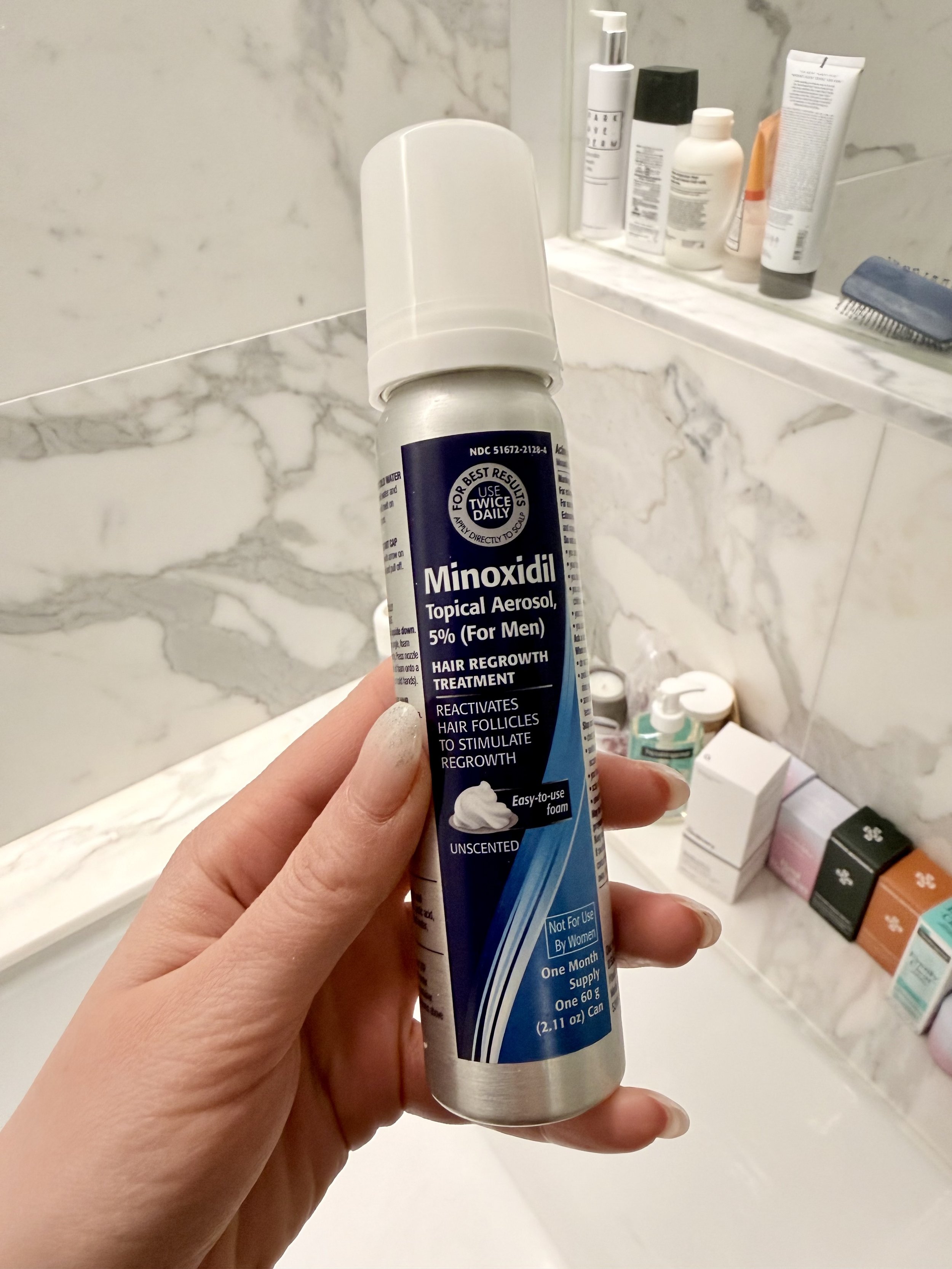
What Is Minoxidil?
Minoxidil is an FDA-approved medication that stimulates hair growth and slows progressive hair thinning. While it was originally developed as a blood pressure medication, researchers discovered that one of its side effects was increased hair growth. Today, topical minoxidil is widely available without a prescription and is considered a first-line treatment for pattern hair loss.
Although the exact mechanism isn't completely understood, minoxidil appears to:
Prolong the hair growth (anagen) phase
Increase blood flow around hair follicles
Increase hair follicle size
Help produce thicker, longer hairs
Unlike many products marketed for hair growth, minoxidil has decades of clinical evidence supporting its effectiveness.
Who Can Benefit from Minoxidil?
One of the biggest misconceptions is that minoxidil is only for male pattern hair loss.
In reality, I recommend minoxidil for many different types of hair loss in my practice, including:
Androgenetic alopecia (male and female pattern hair loss)
Postpartum hair loss
Menopause-related hair thinning
Persistent alopecia areata
Certain scarring alopecias as part of a comprehensive treatment plan
While minoxidil is an excellent option for many patients, it isn't the right choice for everyone. The decision depends on your diagnosis, medical history, lifestyle, and treatment goals.
Important Note: Topical and oral minoxidil are generally not recommended during pregnancy or while trying to conceive. If you are pregnant, planning a pregnancy, or breastfeeding, speak with your dermatologist about alternative treatment options.
Topical vs. Oral Minoxidil
Although topical minoxidil is available without a prescription, oral minoxidil has become increasingly popular in dermatology over the past several years. Oral minoxidil is also getting an update. An extended-release formulation called VDPHL01 is currently in late-stage clinical development for pattern hair loss. I cover VDPHL01, PP405, Breezula, and other new hair loss treatments in development in my 2026 guide.
Both can be effective when prescribed appropriately, but each has advantages.
Topical Minoxidil
Pros
Available over the counter
Minimal systemic side effects
Extensive safety data
Appropriate for many patients
Cons
Requires consistent daily application
Can cause scalp irritation
Some people dislike the texture
Oral Minoxidil
Pros
Easy to take
Often better adherence
Avoids issues with topical application
Cons
Prescription only
Potential side effects including dizziness, swelling, unwanted hair growth, and palpitations
Not appropriate for everyone
The best treatment is ultimately the one that fits your lifestyle and that you'll consistently use.
Should You Use 2% or 5% Minoxidil?
Patients often ask whether higher concentrations work better.
I always recommend 5% minoxidil because studies consistently demonstrate better results compared with 2%.
What about 6% or 7% compounded formulations?
At this time, there's little evidence showing that concentrations above 5% provide meaningful additional growth, although there may be an incremental benefit. Higher concentrations however are associated with more irritation. So, for most people, using a standard 5% formulation consistently is far more important than increasing the concentration.
The brand itself matters much less than the concentration. Generic 5% minoxidil from a reputable manufacturer performs just as well as name-brand products.
Foam vs. Solution: Which Is Better?
Neither formulation is universally better, but each has advantages.
I often recommend the foam formulation because it's less likely to cause irritation or flaking. Many liquid solutions contain propylene glycol, which can irritate sensitive scalps.
Some patients also find that foam dries more quickly and leaves less residue.
On the other hand, the solution may:
Be easier to apply directly to the scalp
Be less expensive
Work well for people who don't experience irritation
Ultimately, the best formulation is the one you'll use consistently every day.
Does Minoxidil Cause Shedding?
Yes, but this is usually a good sign.
Many patients notice increased shedding during the first several weeks of treatment. While this can be alarming, it's typically temporary and occurs because hairs are transitioning into a new growth cycle.
This early shedding does not mean you're permanently losing more hair. In fact, it's often an indication that the medication is beginning to work.
How Long Does Minoxidil Take to Work?
Hair grows slowly, so patience is important.
Most patients begin noticing reduced shedding within several months, while visible improvement often takes 6 to 9 months. Maximum benefit may continue to develop over the course of a year.
Consistency is critical. Missing applications regularly will reduce effectiveness.
Common Side Effects
Topical minoxidil is generally very well tolerated.
The most common side effects include:
Mild scalp irritation
Itching
Flaking
Temporary increased shedding early in treatment
Rarely, repeated application outside the scalp can stimulate unwanted facial hair growth. This typically resolves after stopping application to those areas.
If irritation develops, switching between the foam and solution formulations may help. Persistent side effects should be discussed with your dermatologist.
Common Reasons Minoxidil Doesn't Work
Watch: I recently explained the five most common reasons minoxidil doesn't work in this short Instagram video.
Can You Stop Using Minoxidil?
Minoxidil helps maintain existing hair growth, but it does not permanently cure most forms of hair loss.
If treatment is discontinued, any benefits achieved are generally lost over several months, particularly in patients with androgenetic alopecia.
For this reason, I encourage patients to think of minoxidil similarly to brushing their teeth or wearing sunscreen. It's a long-term maintenance treatment rather than a short-term cure.
The Bottom Line
Minoxidil remains one of the most effective, well-studied, and accessible treatments for hair loss. Whether you're experiencing pattern hair loss, increased shedding, or another form of alopecia, it can be an excellent option when used consistently and as part of an individualized treatment plan.
If you're unsure whether minoxidil is right for you, an evaluation by a board-certified dermatologist can help determine the underlying cause of your hair loss and develop a treatment plan tailored to your goals.
About the Author
Dr. Dawn Queen, MD is a board-certified dermatologist in New York City specializing in medical dermatology, cosmetic dermatology, and hair loss. She serves as a Clinical Assistant Professor of Dermatology at Columbia University and completed an ISHRS-accredited hair restoration fellowship.
Learn more about Dr. Queen.
Frequently Asked Questions
Does minoxidil cause shedding?
Yes, temporary shedding can occur during the first several weeks of treatment. While this can be alarming, it's usually a sign that older hairs are being replaced as new hairs enter the growth phase. In most cases, the shedding is temporary, and I encourage patients to continue treatment unless advised otherwise by their dermatologist.
Can women use minoxidil?
Absolutely. Minoxidil is one of the most effective over-the-counter treatments for female pattern hair loss and may also be recommended for other types of hair loss. The key is making sure you have the correct diagnosis, since not every cause of hair loss responds to minoxidil.
Can I stop using minoxidil once my hair grows back?
For most people with pattern hair loss, minoxidil is a long-term treatment. If you stop using it, the hairs supported by the medication will gradually return to their previous state over several months. Think of it as maintenance rather than a cure.
Foam or solution: which is better?
Neither is universally better. I often recommend the foam because it's less likely to cause irritation, but some patients prefer the liquid because it's easier to apply directly to the scalp. The best formulation is the one you'll use consistently.
Can I combine minoxidil with other hair loss treatments?
Yes. Minoxidil is commonly combined with treatments such as oral medications, PRP, low-level laser therapy, or hair transplantation. In fact, combination therapy often produces better results than any single treatment alone.
Can minoxidil help with hair shedding after Ozempic or other GLP-1 medications?
It depends on the cause of your shedding. If your hair loss is due to telogen effluvium triggered by rapid weight loss, the shedding is often temporary and may improve on its own once the underlying trigger has resolved. In these cases, not everyone needs treatment with minoxidil.
However, if a GLP-1 medication has unmasked underlying female or male pattern hair loss (androgenetic alopecia), minoxidil may help stimulate hair growth and slow further thinning. Because multiple forms of hair loss can occur at the same time, it's often helpful to see a dermatologist for an accurate diagnosis before starting treatment.
Related: Does Ozempic Cause Hair Loss? Why GLP-1 Medications May Cause Hair Shedding
