
Hair Shedding vs Hair Loss: How to Tell the Difference
Many people worry about hair loss when they notice hair in the shower or on their brush.
However, not all shedding means permanent hair loss. Hair naturally goes through cycles of growth, rest, and shedding.
Understanding the difference between normal shedding and true hair loss can help determine when medical evaluation may be helpful.
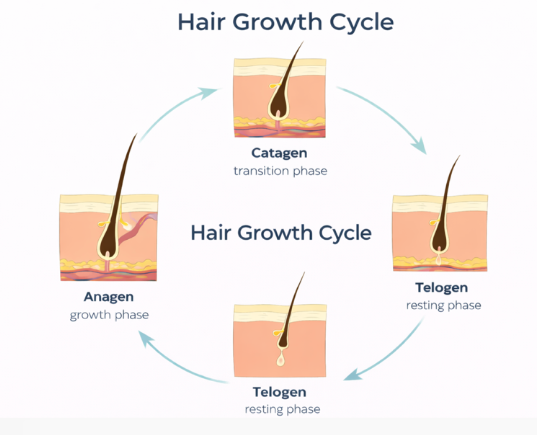
How the Hair Growth Cycle Works
Hair follicles cycle through three main phases:
Anagen (growth phase)
Hair actively grows for several years.
Catagen (transition phase)
Growth slows and the follicle prepares to shed.
Telogen (resting phase)
The hair eventually sheds and a new hair begins to grow.
Because thousands of follicles are in different phases at any given time, daily shedding is normal.
Normal Hair Shedding
Most people naturally shed 50–100 hairs per day.
This shedding often becomes more noticeable during:
Showering
Brushing or styling
Seasonal changes
Importantly, normal shedding does not cause visible thinning of the hair.
Excessive Shedding (Telogen Effluvium)
When a larger number of hairs enter the shedding phase at once, the condition is called telogen effluvium.
This can occur after events such as:
Illness or fever
Surgery
Significant stress
Rapid weight loss
Hormonal changes
Iron deficiency or thyroid disorders
Shedding typically begins two to three months after the trigger. Unlike normal shedding, hair loss is rapid and diffuse with a noticeable decrease in density in weeks to months.
Fortunately, in most cases, telogen effluvium improves once the underlying cause is addressed.
True Hair Loss
True hair loss occurs when hair follicles miniaturize or stop producing hair.
Common patterns include:
Widening of the part
Gradual thinning on the top of the scalp
Recession of the hairline
Patchy hair loss
These changes may indicate conditions such as male orfemale pattern hair loss, alopecia areata, or scarring alopecia.
When to See a Dermatologist
Evaluation may be helpful if you notice:
Increasing hair shedding lasting > 6 months
Visible thinning or widening of the part
Patchy areas of hair loss
Scalp symptoms such as itching, burning, or redness
A dermatologist can help determine the underlying cause and recommend appropriate treatment.
The Bottom Line
Seeing hair fall out can be concerning, but shedding is a normal part of the hair growth cycle.
However, persistent shedding, visible thinning, or patchy hair loss may signal an underlying condition.
Early evaluation can help identify the cause and guide effective treatment.
FAQs: Hair Shedding vs Hair Loss
How much hair shedding is normal?
Most people shed about 50–100 hairs per day as part of the normal hair growth cycle. Because many hairs are shed during washing or brushing, the shedding may appear more noticeable on those days.
Normal shedding does not usually cause visible thinning of the hair.
Does washing or brushing your hair cause hair loss?
No. Washing or brushing the hair does not cause hair loss.
These activities simply release hairs that were already in the telogen (shedding) phase of the hair cycle.
In fact, if you wash your hair less frequently, shedding can sometimes appear more dramatic, because several days’ worth of naturally shed hairs may come out at once during washing or brushing.
For example, if someone washes their hair once every few days instead of daily, they may simply notice a larger number of shed hairs in a single shower, even though the total amount of shedding is the same.
Seeing hair in the shower drain can look alarming, but most of those hairs were already destined to shed.
Can stress cause hair loss?
Yes. Significant physical or emotional stress can trigger a condition called telogen effluvium, where many hairs enter the shedding phase at the same time.
Common triggers include:
Illness or high fever
Surgery
Rapid weight loss
Childbirth
Severe psychological stress
Shedding typically begins 2–3 months after the trigger. Fortunately this type of hair loss will self-correct over 6-9 months if the trigger subsides.
Will hair grow back after excessive shedding?
In many cases, yes.
When shedding is caused by telogen effluvium, hair growth usually improves once the underlying trigger resolves. However, regrowth may take several months because hair grows slowly.
If shedding persists beyond six months, evaluation by a dermatologist may be helpful.
When should I see a dermatologist for hair shedding?
You should consider evaluation if you notice:
Persistent shedding lasting > 6 months
Visible thinning or widening of the hair part
Patchy hair loss
Scalp symptoms such as itching, burning, or redness
A dermatologist can evaluate for conditions such as female pattern hair loss, alopecia areata, or underlying medical triggers.
Can nutritional deficiencies cause hair shedding?
Yes. Several nutritional deficiencies can contribute to increased shedding, including:
Low iron levels
Low ferritin
Low vitamin D (possibly, this is debated)
Low protein intake
Low zinc
Hair shedding may also occur after rapid weight loss or very restrictive diets, which can place stress on the hair growth cycle.
Bloodwork may sometimes be recommended to evaluate for underlying contributors.
Is it normal to lose more hair at certain times of the year?
Some people experience seasonal increases in shedding, particularly in late summer or early fall. This is thought to be related to normal fluctuations in the hair cycle.
In most cases, this shedding is temporary.
Can medications like Ozempic or other GLP-1 drugs cause hair shedding?
Some patients taking GLP-1 medications (such as Ozempic) report increased hair shedding.
In most cases, this is not caused directly by the medication itself. Instead, hair shedding may occur because rapid weight loss can trigger telogen effluvium, a temporary condition in which more hairs enter the shedding phase of the hair cycle.
This type of shedding typically begins two to three months after significant weight loss and often improves once weight stabilizes and the hair cycle resets.
