
How to Build a Skincare Routine: A Dermatologist's Step-by-Step Framework
Skincare does not need to be complicated to be effective.
Most people aren't under-treating their skin — they're overcomplicating their routine. If you’ve ever felt overwhelmed by 10-step routines or unsure which products actually matter, this guide walks you through the same strategic framework I use when designing skincare plans for my patients.
Step 1: Understand Your Skin (Beyond “Dry” or “Oily”)
Instead of labeling skin as dry or oily alone, dermatologists think in terms of behavior and risk.
Ask yourself:
Does my skin sting, burn, or feel tight after washing?
Do I break out even when using “gentle” products?
Do I get redness or irritation easily?
Do dark spots linger after acne heals?
Does my skin feel oily but still flaky?
Does my skin worsen when I try new products?
If you checked several of these, your skin barrier may need priority repair before introducing strong active ingredients.
When the barrier is compromised, introducing strong active ingredients too quickly can lead to burning, irritation, and worsening inflammation rather than improvement.
In this situation, it’s still important to build the core routine outlined in Step 2, but the focus should be on gentle cleansing, moisturizing, and sun protection first.
Once the skin barrier feels stable (meaning less burning, stinging, or redness), targeted treatments from Step 3 can be introduced slowly.
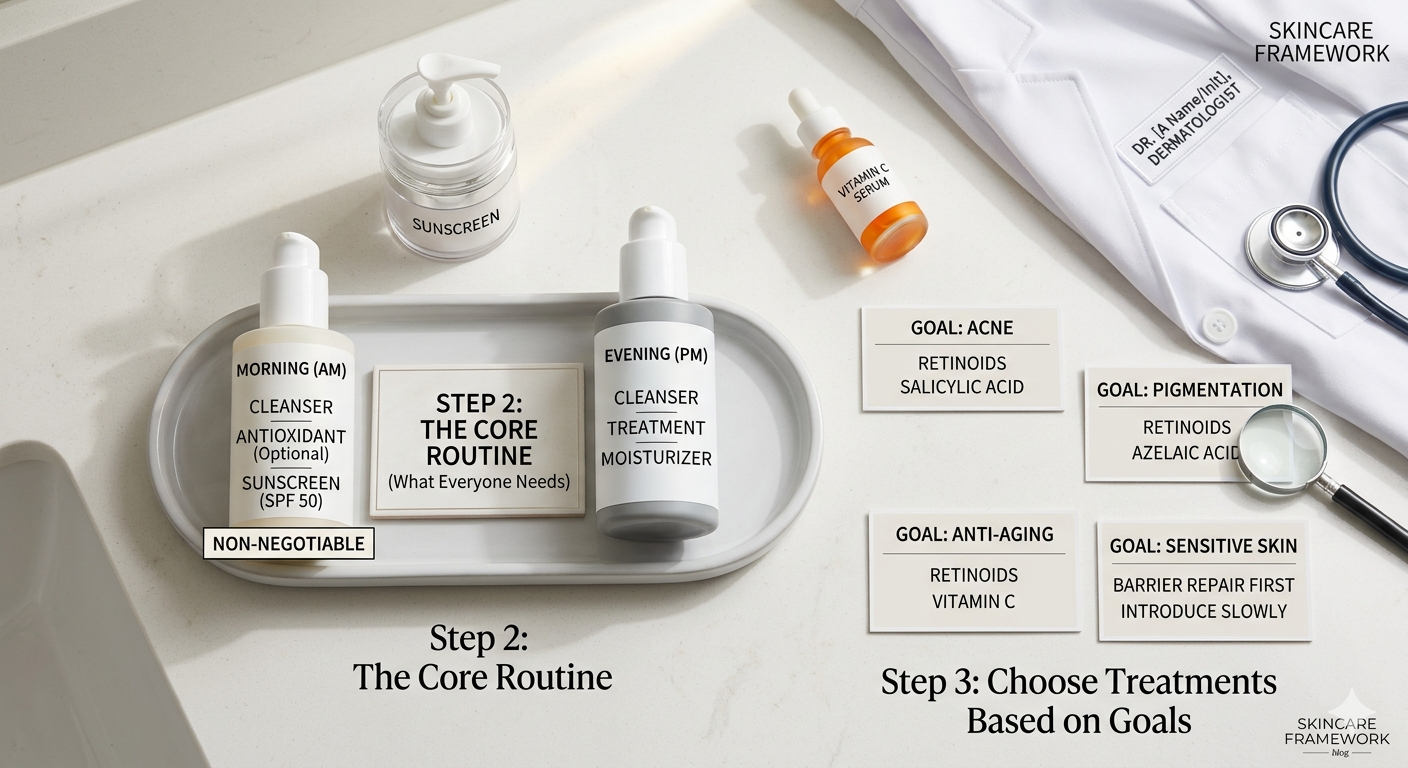
Step 2: The Core Routine (What Everyone Needs)
No matter your skin type, the structure stays the same. Customization comes later.
Morning (AM)
Cleanser
Antioxidant (optional but beneficial)
Moisturizer
Sunscreen (non-negotiable)
Evening (PM)
Cleanser
Targeted treatment
Moisturizer
If a product doesn’t fit into one of these steps, it’s usually optional, not essential. This is why many effective skincare routines contain only three to four products.
This structure simplifies decision-making and prevents over-layering.
Step 3: Choose Treatments Based on Goals (Not Hype)
More products do not equal better results. Consistency does.
Pick one primary goal and build around it. See below for examples of over-the-counter targeted treatments.
If Your Concern Is Acne:
Retinoids
Benzoyl peroxide
Salicylic acid
Non-comedogenic moisturizer
If Your Concern Is Pigmentation, Melasma and Dark Spots:
Retinoids
Azelaic acid
Daily sunscreen
If Your Concern Is Sensitive or Reactive Skin:
Barrier repair first
Delay strong actives
Introduce treatments slowly
If Your Concern Is Anti-Aging:
Retinoids
Antioxidants (Vitamin C)
Hydrators (Hyaluronic acid)
Consistent sun protection
The mistake many people make is stacking actives. Instead, treat the concern that bothers you most first.
OTC vs Prescription: How Dermatologists Decide
Over-the-counter products are often effective for:
Mild acne
Early pigment changes
Maintenance routines
Prescription treatments are typically considered when skin concerns are:
Persistent
Worsening
Not improving after 8–12 weeks of consistent care
Prescriptions are not “stronger skincare.” They are targeted medical treatments used when appropriate and guided by a dermatologist.
Step 4: How to Introduce New Products Safely
When building or upgrading your routine:
Add one new product at a time
Wait 1–2 weeks before adding another active
Start actives 2–3 nights per week
Do not skip moisturizer
If your skin burns or stings, pause
Burning is not a sign that a product is “working.” It is often a sign that your barrier needs support.
Step 5: Common Skincare Mistakes That Delay Results
Starting multiple actives at once
Chasing trends instead of consistency
Skipping sunscreen in winter or on cloudy days
Using prescription-strength products without supervision
Confusing irritation with “purging” and pushing through damage
The most effective routines are often the simplest.
When to See a Dermatologist
If your skin isn’t improving after 8–12 weeks of a targeted, consistent routine, or if irritation keeps recurring, it may be time for a personalized plan.
A consultation can simplify your routine, clarify which treatments are worth your time, and determine whether prescription options are appropriate.
About the Author
Dr. Dawn Queen, MD is a board-certified dermatologist in New York City specializing in medical dermatology, cosmetic dermatology, and hair loss. She serves as a Clinical Assistant Professor of Dermatology at Columbia University and completed an ISHRS-accredited hair restoration fellowship.
Learn more about Dr. Queen.
Frequently Asked Questions
How Long Does It Take for a Skincare Routine to Work?
Most skincare treatments take 6–12 weeks to show meaningful improvement. Skin cells turn over roughly every 28–40 days, so changes usually appear gradually.
Acne treatments and retinoids often take the longest to show visible improvement, while hydration and barrier repair can sometimes improve skin within days.
Consistency is the most important factor.
What are the most important skincare products?
For most people, the foundation of a skincare routine includes a gentle cleanser, moisturizer, and daily sunscreen. Additional products, such as retinoids, vitamin C, or exfoliants, can be added based on individual skin concerns and goals.
Do I Need Toner in My Skincare Routine?
For most people, toner is optional.
Modern cleansers are already pH-balanced, so toner is no longer necessary to “reset” the skin after washing. Some toners can provide mild exfoliation or hydration, but they are not essential steps in a routine.
If you use one, it should serve a clear purpose, not just add another layer.
Should I Use Retinol Every Night?
Not necessarily.
Many people benefit from starting retinoids 2–3 nights per week and gradually increasing frequency as their skin tolerates it. Using retinoids too frequently early on can lead to irritation and barrier disruption.
Slow, consistent use tends to produce the best long-term results.
In What Order Should I Apply Skincare Products?
A helpful rule is to apply products from thinnest to thickest texture. See “The Correct Order to Layer Your Skincare”.
