
Best Treatments for Acne Scars: Which Option Is Right for You?
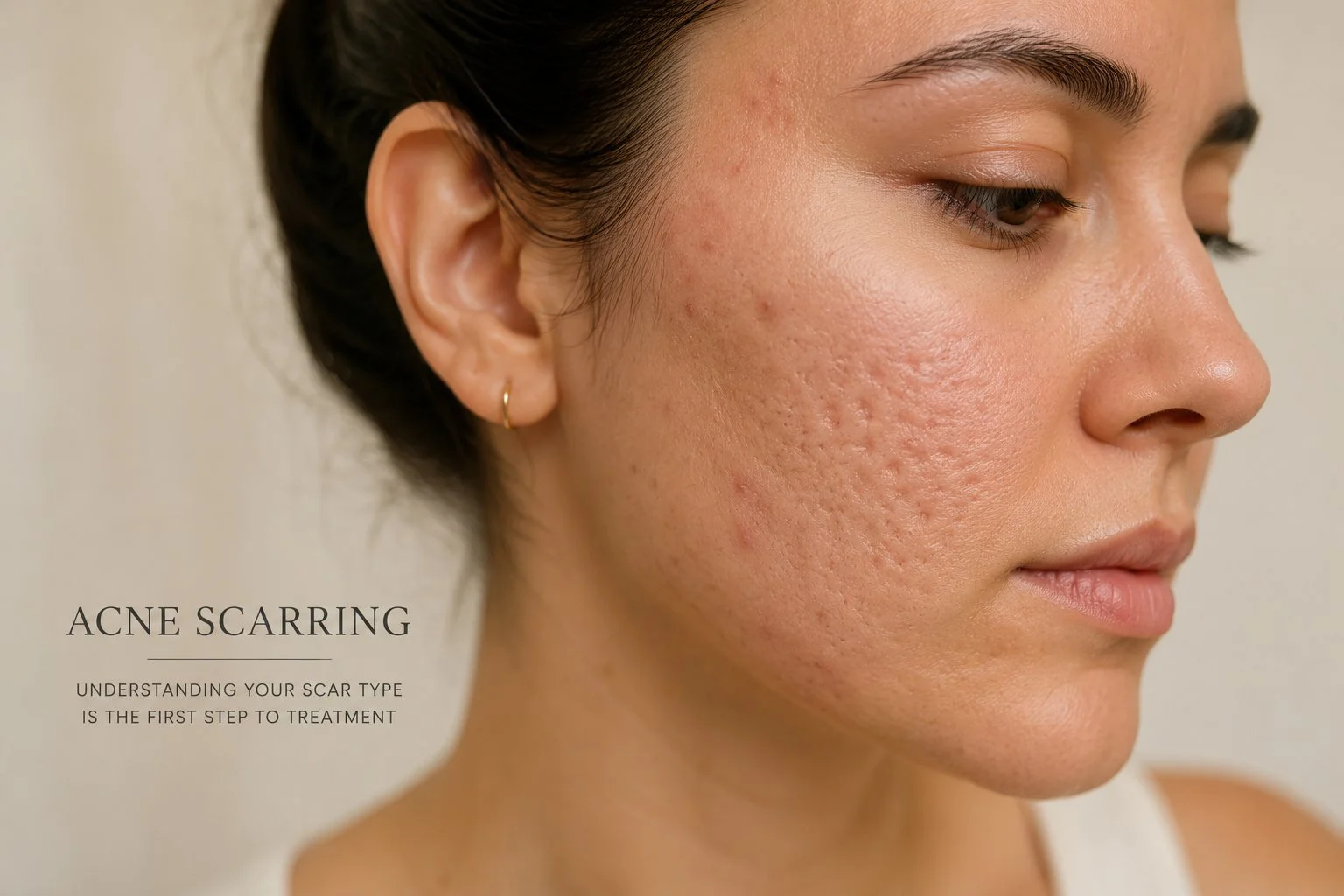
Acne scars can persist long after active breakouts have resolved. While many people refer to any leftover mark as an "acne scar," true scars are different from the dark marks that often remain after acne heals.
Understanding the type of mark you have is the first step toward choosing the most effective treatment.
Acne Scars vs. Dark Marks
One of the most common misconceptions is that acne scars and dark marks are the same thing.
Post-inflammatory hyperpigmentation (PIH)
Flat brown, tan, or gray spots
Caused by excess pigment after inflammation
Usually fade gradually over time
Often improve with topical skincare and sun protection
Acne Scars
Indented or raised changes in the skin
Caused by damage to the skin's underlying collagen
Do not typically improve on their own
Often require in-office procedures
Because these conditions have different causes, they require different treatments.
Why Do Acne Scars Form?
Acne scars develop when deeper inflammation damages the skin's collagen during healing.
As the skin repairs itself, collagen production may be reduced or excessive, resulting in permanent textural changes.
The risk of scarring is higher with:
Deep inflammatory acne
Cystic acne
Delayed treatment
Picking or squeezing pimples
Treating acne early is one of the best ways to prevent scars from developing.
The Different Types of Acne Scars
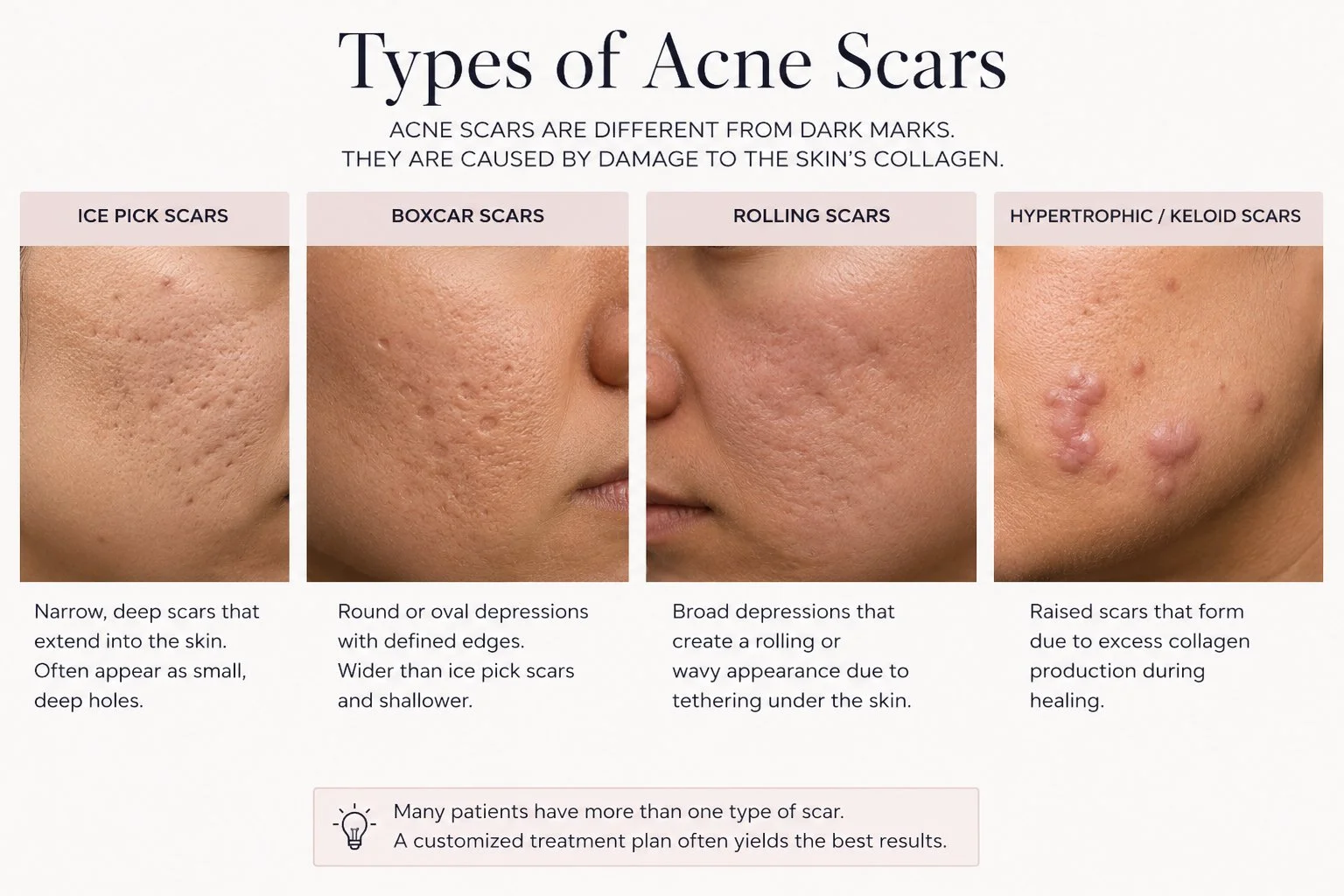
Not all acne scars are the same.
Ice Pick Scars
Ice pick scars are narrow, deep scars that extend into the skin.
Because they are deep, they are often among the most challenging scars to treat.
Boxcar Scars
Boxcar scars appear as round or oval depressions with sharply defined edges.
They are commonly found on the cheeks and temples.
Rolling Scars
Rolling scars create broad depressions that give the skin an uneven or "rolling" appearance.
These scars are often caused by fibrous bands pulling the skin downward.
Hypertrophic and Keloid Scars
Rather than forming depressions, these scars become raised due to excess collagen production.
They are more commonly seen on the chest, shoulders, jawline, and back.
Why Scar Type Matters
Different scar types respond to different treatments.
For example:
Ice pick scars may benefit from TCA CROSS or punch techniques.
Rolling scars often respond well to subcision.
Boxcar scars frequently improve with fractional laser resurfacing.
Raised scars may require steroid injections or other targeted treatments.
Many patients have several scar types at the same time, which is why combination treatment often produces the best results.
Treatment Options for Acne Scars
Fractional Laser Resurfacing
Fractional lasers create controlled areas of injury within the skin, stimulating new collagen production as the skin heals.
These treatments are commonly used for:
Boxcar scars
Rolling scars
Overall skin texture
Improvement occurs gradually over several months as collagen remodels.
Microneedling
Microneedling uses fine needles to create controlled micro-injuries that stimulate collagen production.
It may improve:
Mild acne scars
Skin texture
Overall skin quality
Multiple treatment sessions are usually recommended.
Subcision
Rolling scars are often tethered to deeper tissues by fibrous bands. This is one of my favorite treatments.
Subcision uses a specialized needle to release these bands, allowing the skin to elevate more naturally.
This treatment is frequently combined with other procedures for optimal improvement.
Chemical Peels
Chemical peels primarily improve superficial discoloration and mild textural changes.
They are often combined with other scar treatments but are generally less effective for deeper scars.
Dermal Fillers
Some depressed scars can be temporarily elevated using dermal fillers.
This approach is most useful for selected rolling or boxcar scars. Don’t discount this option.
Combination Treatment
Most patients have more than one scar type. Combo treatment is my preferred approach.
For this reason, dermatologists often combine several procedures to achieve the best cosmetic outcome.
A personalized treatment plan frequently produces better results than relying on a single procedure.
Can Skincare Products Remove Acne Scars?
Topical skincare products can improve:
Post-inflammatory hyperpigmentation
Skin texture
Overall skin quality
However, they cannot rebuild collagen that has already been lost.
True acne scars generally require procedural treatments.
How Long Does Treatment Take?
Collagen remodeling occurs gradually.
Most patients notice progressive improvement over several months, with multiple treatment sessions often recommended depending on scar severity.
When Should You See a Dermatologist?
A consultation may be helpful if:
Acne scars affect your confidence.
Over-the-counter products have not improved skin texture.
You are unsure whether you have scars or dark marks.
You continue developing new acne while trying to treat existing scars.
Early treatment can often prevent scars from becoming more noticeable over time.
The Bottom Line
Acne scars are caused by permanent changes in the skin's collagen following inflammation.
Because different scar types respond to different procedures, identifying the type of scar is one of the most important steps in choosing the right treatment.
Many patients achieve meaningful improvement with a personalized treatment plan that combines multiple techniques.
About the Author
Dr. Dawn Queen, MD is a board-certified dermatologist in New York City specializing in medical dermatology, cosmetic dermatology, and hair loss. She serves as a Clinical Assistant Professor of Dermatology at Columbia University and completed an ISHRS-accredited hair restoration fellowship.
Learn more about Dr. Queen.
Frequently Asked Questions
Can acne scars go away on their own?
True acne scars generally do not disappear without treatment because they result from permanent changes in the skin's collagen. However, dark marks left behind after acne often fade gradually over time.
What is the best treatment for acne scars?
The best treatment depends on the type of scar. Fractional lasers, microneedling, subcision, TCA CROSS, chemical peels, fillers, and combination therapy all have different roles depending on the scar pattern.
What is the difference between acne scars and dark marks?
Dark marks (post-inflammatory hyperpigmentation) are caused by excess pigment and are usually flat. Acne scars involve permanent structural changes in the skin and often appear indented or raised.
Is laser treatment better than microneedling for acne scars?
Neither treatment is universally better. Fractional lasers often provide greater improvement for deeper scars, while microneedling may be appropriate for milder scars or certain skin types. The best approach depends on the type of acne scar being treated.
Can microneedling remove acne scars?
Microneedling can improve the appearance of many mild to moderate acne scars by stimulating collagen production. Multiple treatment sessions are usually required, and deeper scars often benefit from combination therapy.
How many acne scar treatments will I need?
Most patients require multiple sessions. The number of treatments depends on the type, depth, and severity of the scars, as well as the procedure being performed.
Can acne scars be prevented?
The best way to prevent acne scars is to treat inflammatory acne early and avoid picking or squeezing pimples. Prompt treatment can reduce inflammation and decrease the risk of permanent scarring.
Are acne scars permanent?
Many acne scars are permanent, but they can often be improved significantly with procedural treatments that stimulate collagen remodeling or release scar tissue.
