
For many women considering a hair transplant, one of the biggest concerns isn't the procedure itself. It's the thought of having to shave their heads.
The good news? You don't need to shave your entire head to get a hair transplant! With a technique called follicular unit transplantation (FUT), only a narrow strip of hair at the back of the scalp needs to be shaved. This area can typically be concealed by the surrounding hair, allowing you to maintain your existing hairstyle.
As a board-certified dermatologist and fellowship-trained hair transplant surgeon in New York City, I frequently discuss this concern with women exploring their hair restoration options. Here's what you should know.
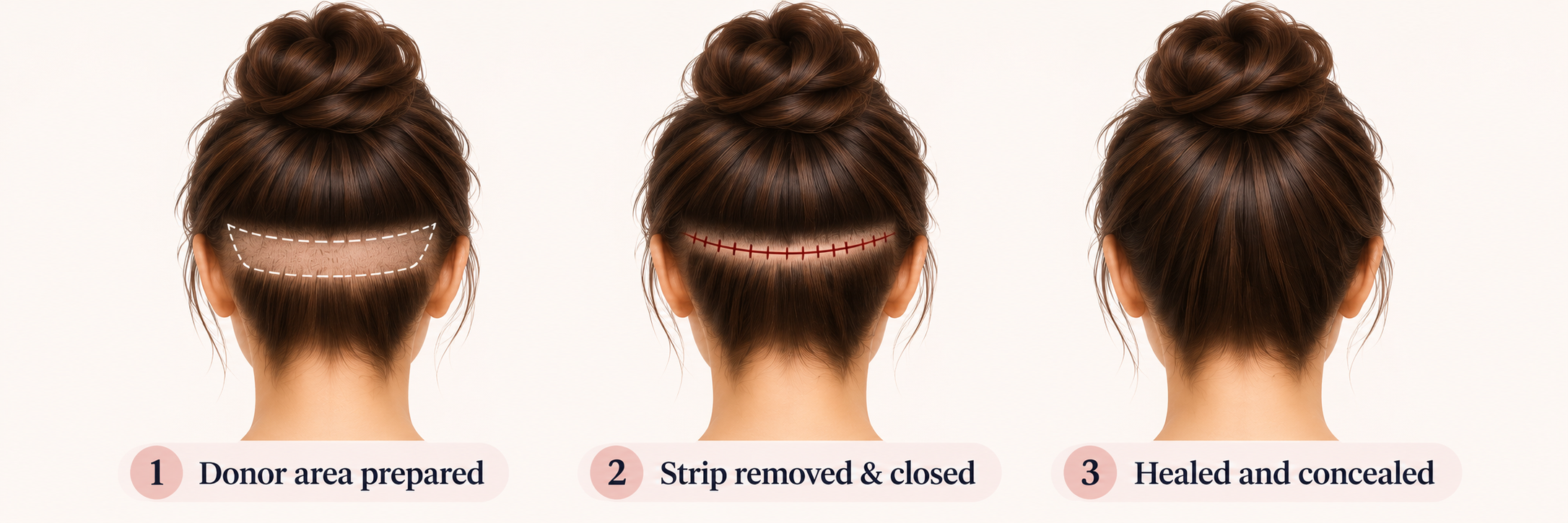
How FUT hair transplantation works: Only a narrow strip of hair at the back of the scalp is shaved and removed. The incision is closed, leaving a linear scar that can typically be concealed by the surrounding hair, allowing women to maintain their existing hairstyle.
What Is FUT Hair Transplantation?
Follicular unit transplantation (FUT), also known as the strip method, is a hair restoration technique in which a narrow strip of hair-bearing scalp is surgically removed from the donor area, typically at the back of the head. Think of it as a simple skin surgery.
The strip is then carefully dissected by the technicians into individual follicular units, each containing approximately one to four hairs. These grafts are transplanted into areas of thinning or hair loss, where they can grow naturally over time.
Unlike follicular unit extraction (FUE), which typically requires shaving a larger donor area, FUT allows the surgeon to harvest hair follicles from a narrow, concealed section of the scalp.
For women who want to preserve their existing hairstyle, this can be a major advantage.
Do You Have to Shave Your Hair for FUT?
Technically, yes—but much less than you might think.
With FUT, only the narrow strip of hair that will be removed needs to be shaved or trimmed. The surrounding hair remains long and can typically cover the donor area after the procedure.
This means you generally won't need to shave the top, sides, or majority of the back of your head.
For women with longer hair, the donor incision can often be concealed by the hair above it. Of course, how well it is hidden depends on your hair length, density, and hairstyle.
The recipient area, where the new follicles are implanted, can also generally be left unshaven and the hair follicles will be transplanted between your existing hair.
Why FUT May Be a Good Option for Women
Although both FUT and FUE can be performed in women, FUT offers several advantages for patients who want to minimize visible changes to their hair during recovery.
1. Minimal shaving
Only a narrow strip at the back of the scalp needs to be shaved, rather than a larger donor area.
2. Preservation of your existing hairstyle
Because the surrounding hair remains long, many women can continue wearing their hair down to conceal the donor area.
3. Efficient graft harvesting
FUT allows multiple follicular units to be harvested from a single strip of donor tissue, making it an efficient option when a substantial number of grafts is needed.
4. Preservation of surrounding donor hair
FUT concentrates harvesting within a defined strip rather than extracting individual follicular units throughout a broader donor region. Depending on the patient's long-term hair restoration goals, this may be advantageous for donor management.
However, FUT does leave a fine, linear scar at the donor site. While this is often concealed by longer hair, it may become visible with very short hairstyles.
Who Is a Good Candidate for a Female Hair Transplant?
Not all types of hair loss are suitable for transplantation. The best candidates generally have a stable pattern of hair loss and sufficient healthy donor hair.
Women who may benefit include those with:
A naturally high hairline or large forehead: Hair transplantation can help lower or reshape the hairline.
Traction alopecia: Stable hair loss caused by chronic tension from tight hairstyles may be amenable to transplantation.
Localized hair loss: Certain areas of permanent, stable hair loss may be suitable for surgical restoration.
Female pattern hair loss: Selected women may benefit if they have adequate donor density and a well-defined area to treat.
Scarring hair loss: Certain types of scarring hair loss, including frontal fibrosing alopecia (FFA) and lichen planopilaris (LPP), may be considered for transplantation when the underlying disease has been adequately controlled and stable, often for at least 12–24 months.
For women with diffuse thinning, determining whether the donor area is also affected is particularly important.
A comprehensive evaluation by a dermatologist experienced in hair loss and transplantation is essential to determine candidacy, particularly in patients with inflammatory or scarring alopecias.
What Does Recovery Look Like After FUT?
Although FUT allows most of the existing hair to remain long, it is still a surgical procedure with a recovery period.
The first week: Mild discomfort, tightness, swelling, and small crusts around the transplanted follicles are common. The donor incision is typically concealed by surrounding hair, although the recipient area may be more noticeable.
Days 10–14: Sutures or staples, if used, are generally removed around this time. Most of the initial crusting has also resolved.
Weeks 2–8: Transplanted hairs commonly shed as part of the normal postoperative process. This is expected and does not mean the grafts have failed.
Months 3–4: Most of the transplanted hairs have shed, and early new growth may begin to emerge. Visible improvement is often still minimal at this stage.
Months 6–12: New hair growth becomes more noticeable, with gradual improvements in density and coverage.
12–18 months: Final results continue to mature, particularly in some areas of the scalp.
Recovery and growth timelines vary between patients.
Will People Be Able to Tell I Had a Hair Transplant?
One of the biggest advantages of FUT for women is that the donor area can often be hidden beneath the existing hair.
However, minimal shaving doesn't necessarily mean an invisible recovery.
Depending on the location and number of grafts, there may still be temporary redness, swelling, or crusting in the recipient area. The donor incision also requires time to heal and will leave a linear scar.
For women who wear their hair long, the ability to conceal the donor area can make the recovery process easier to manage discreetly.
About the Author
Dr. Dawn Queen, MD is a board-certified dermatologist in New York City specializing in medical dermatology, cosmetic dermatology, and hair loss. She serves as a Clinical Assistant Professor of Dermatology at Columbia University and completed an ISHRS-accredited hair restoration fellowship.
Learn more about Dr. Queen.
Frequently Asked Questions About PRP for Hair Loss
Can women get a hair transplant without shaving their heads?
Yes! With FUT (follicular unit transplantation), only a narrow strip of hair at the back of the scalp needs to be shaved. The surrounding hair remains long and can typically conceal the donor area, allowing you to maintain your existing hairstyle.
Is FUT better than FUE for women?
Neither technique is inherently better. However, FUT may be particularly appealing to women who want to avoid shaving a larger portion of their hair. FUE avoids a linear scar but typically requires shaving a larger donor area (the back of the head).
Does FUT leave a scar?
Yes. FUT leaves a linear scar at the back of the scalp where the donor strip is removed. This is typically concealed by surrounding hair, particularly in women with longer hairstyles. However, the scar is permanent and may be visible with certain hairstyles.
Do you have to shave the recipient area for a female hair transplant?
Not necessarily and in fact we don’t in our practice. Hair follicles can generally be transplanted between existing hairs without shaving the recipient area. This allows women to preserve much of their existing hairstyle throughout the process.
How long does it take to see results from a female hair transplant?
Most transplanted hairs shed within the first several weeks after surgery. New growth typically begins around months 3–4, although visible improvement may still be minimal. More noticeable results develop around months 6–9, with continued maturation over 12–18 months.
Can women with scarring alopecia get a hair transplant?
Yes, selected patients with scarring alopecia may be candidates for hair transplantation once the underlying disease has been adequately controlled and stable, often for at least 12–24 months. However, graft survival may be less predictable, and there is a risk of disease reactivation. A thorough evaluation is essential to determine candidacy.
